
In short
- Choose on ownership, crew, held output and paperwork before you look at the rate. A rate means something only once the scope behind it is known.
- Ask whether the plant is owned or hired, where the wear parts are kept and who the operators are. Those three answers predict downtime.
- Ask for output held over a run of months on a named package, not for a plant capacity.
- Settle royalty, transit passes, weighing and testing in writing before mobilisation.
- Visit a running site. A stockpile yard and a spares store tell you more than a presentation does.
Most crushing contractors are chosen on two things: the rate, and a telephone call to somebody who has used them. Neither tells you what happens in the fourth month, when a cone liner fails on the night shift and the paver is due at the road head in three days.
The way to choose is to ask about the things that decide whether material keeps coming: who owns the plant, who runs it, where the spares are, what output has been held before, who carries the paperwork and what the rate leaves out. Twelve questions cover it. Put them to every bidder, us included.
Ownership: the plant and its spares
- 1. Do you own the plant or hire it? A good answer names the plant, where it is standing today and when it comes free. A bad answer is that a plant will be arranged. A hired plant can be withdrawn by its owner, and you will be the last to hear.
- 2. Where are the wear parts stocked? Good: jaw plates, cone liners, screen mesh, belts and bearings held at the plant, with a list you can see. Bad: the dealer keeps them and delivery is quick. A liner ordered on the day it fails can take weeks. What wears on a crusher explains why the stock matters.
People: who runs it on the night shift
- 3. Who are the operators? Good: a plant operator, jaw and cone attendants, a fitter and an electrician on the contractor's own payroll, who have run that plant before and will live on site. Bad: labour will be taken on locally once the plant is erected. People learning a plant learn it at your project's expense.
Output: what has been held, and how soon
- 4. What output have you held, for how many months, on which package? Good: a monthly tonnage, a duration and a client you can telephone. Bad: a capacity in TPH. Capacity is what the plant could do. You are buying what it did.
- 5. How long to mobilise, and what would delay it? Good: a period with its conditions stated, such as access, season and lease status. Bad: a date with no conditions at all. The first 30 days of a plant set-up shows what a realistic month contains.
- 6. Can I visit a running site? Good: yes, with a name and a location offered in the same breath. Look at the stockpiles, the spares store and the weighbridge cabin.
Paperwork: royalty, weighing and testing
- 7. Who handles royalty and transit passes? Good: a clear split that follows whoever holds the lease, and a named person who does the work. Bad: it will be sorted out locally. A load without its pass is a tipper parked at a check post. Royalty and transit passes sets out what travels with each load.
- 8. How is dispatch weighed? Good: a calibrated weighbridge at the plant and a slip with every load, so that dispatch weight is the billed weight. Bad: by tipper count or body volume. Counting tippers is how month-end reconciliation becomes a meeting.
- 9. Who tests the grading, and when? Good: samples at commissioning and at intervals through the run, sent to the lab your contract nominates, with nothing invoiced before the first results. Bad: an assurance that the material always passes.
Money: the rate and the bad week
- 10. What is outside your rate? Good: a written list, normally power or genset diesel, royalty, transit passes and whatever has been agreed about feed and haulage. Bad: the rate is all-inclusive, with no list attached. What a per-tonne crushing rate includes gives you the list to check against.
- 11. What happens to your payment when the plant is down? Good: payment is per tonne of finished material, so a stopped plant earns the contractor nothing. Bad: any arrangement in which the contractor is paid by the month or the hour whether or not stone is produced. That puts the downtime back on you.
Exit: what leaves with the contractor
- 12. What do you take away at the end? Good: the plant, the machines, the camp and the scrap, with the site cleared and handed back, and a view on foundations and leftover stockpiles agreed at the start. Bad: silence, or surprise at the question. Abandoned steel on your lease becomes your liability.
Documents to ask for
| Document to ask for | Why |
|---|---|
| GST certificate and PAN | The firm on the order is the firm on the invoice, and it can be put on your vendor list |
| Partnership deed or incorporation papers | Shows who is entitled to sign the contract |
| Work orders and completion certificates | Turns a claimed tonnage into one a previous client has confirmed |
| Proof of plant ownership | Separates an owned plant from one hired for the job |
| Weighbridge calibration certificate | The bridge that decides your bill has been checked, and you can see when |
| Blasting licences, where the scope includes blasting | Shotfirer and magazine papers have to exist before explosive reaches site |
Check the name on each document against the name on the quote. Where a firm's record was built under an earlier or sister entity, ask which entity held each work order.
How we answer the first three
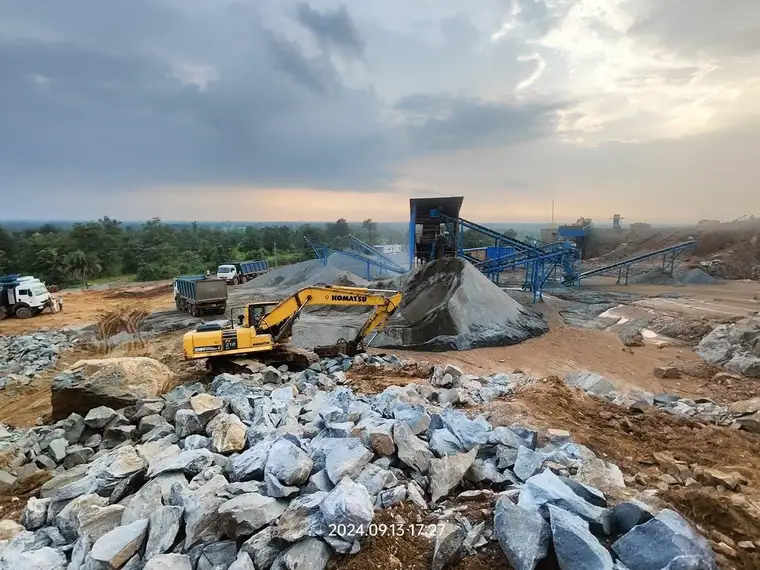
- Owned. Six crusher plants, three-stage, 250 to 350 TPH, all ours. The excavators, tippers, drilling machines and weighbridges are owned as well. Nothing is on hire, so a plant committed to your package is not pulled off to a site that shouts louder.
- At the plant. Jaw plates, cone liners, screen mesh, belts and bearings are stocked on site, and wear parts are our cost inside the rate.
- Our own people. Plant operator, jaw and cone attendants, electrician and fitter who have run these specific plants before. They are on site, not on call from another district.
One more fact belongs with those answers, because question 4 will raise it. SM Infra was registered as a partnership firm in October 2024. The plants and crews have been working since 2000, and work orders from before October 2024 were contracted to our sister firm, Sansar Infra LLP. The project record lists each package with its client and tonnage, and the terms on which we run a plant on a client's site are set out on the service page. Ask us the other nine as well.
Standards and sources
- Plant ownership, crew, wear-part stocking, rate basis and firm history: SM Infra's own operating record
- Blasting carried out by licensed shotfirers under DGMS rules; licence particulars depend on the site and should be checked against the documents supplied
Your contract and its technical schedules override anything written here. Check the clause before you build to it.