
In short
- Owning a plant is a capital decision and an operating commitment. The machine is the smaller half of it.
- A per-tonne crushing contract moves erection, crew, wear parts and downtime onto the crusher operator. Power, royalty and transit passes are agreed separately.
- Owning wins when you have several years of continuous work within reach of one location, a lease of your own and a plant crew you can keep busy.
- Contracting wins when the need is one package long, the site is far from your base, or the programme cannot absorb a learning curve.
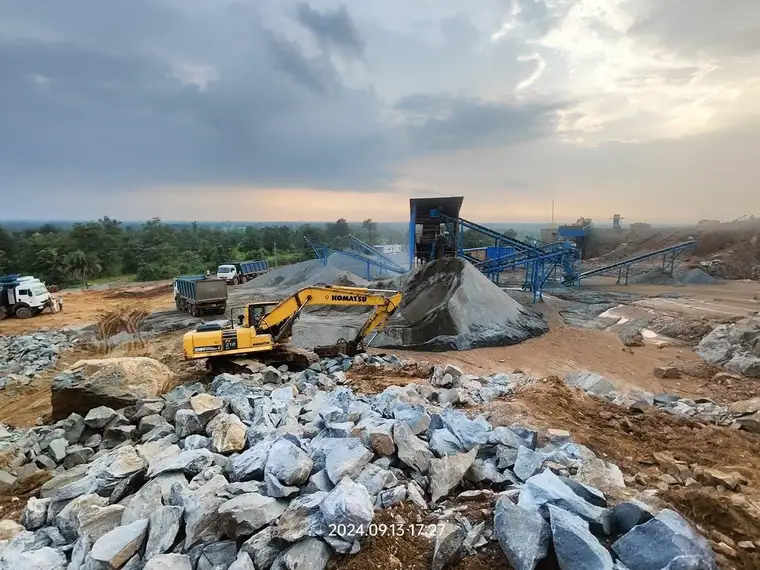
- One 250 TPH three-stage plant is rated for up to 1,00,000 MT a month on two shifts. Size the decision against the tonnes the package needs each month, not against the machine.
Every highway package reaches the same fork early. The road needs several lakh tonnes of GSB, WMM and aggregate, the nearest commercial crusher is either too far or too small, and somebody in the project office asks whether the company should simply buy a plant.
It is a fair question, and the answer is not always no. But it is usually asked as a question about a machine, and the machine is the easy part. This is how the decision looks from the side of a firm that owns six plants and runs them on other people's projects.
What you are actually buying
Nobody on a road project wants a crusher. They want stone at the road head that passes the grading in the site engineer's file, at a known cost per tonne, every working day until the last layer is down. A plant is one way of getting that. A crushing contract is another.
So the useful comparison is not purchase price against contract rate. It is everything you take on to turn a purchased plant into graded material, against a rate per tonne that already contains most of it.
Who carries what
| Item | You own the plant | You contract the crushing |
|---|---|---|
| Capital for the plant | Yours, before the first tonne | The operator's |
| Foundations, erection, commissioning | Yours to organise and pay for | Inside the rate |
| Plant operator, fitter, electrician | On your payroll, between projects too | Inside the rate |
| Jaw plates, cone liners, mesh, belts | Your stock, your lead time | Inside the rate |
| Breakdown and lost output | Your cost and your delay | The operator's cost |
| Power or genset diesel | Yours | Agreed up front, often the client's |
| Mineral lease, royalty, transit passes | Yours | Follows whoever holds the lease |
| Pollution board consents for the plant | Yours to obtain and renew | Agreed up front |
| The plant when the road is finished | Yours to move, store or sell | Leaves with the operator |
The last three contract rows are the ones to settle in writing before mobilisation. On most of our projects the client holds the lease and we hold the plant, the crew and the output number.
The crew is harder to buy than the crusher
A three-stage plant can be ordered. The people who know why the grading drifted before the lab report arrives cannot. A plant needs an operator, jaw and cone attendants, a fitter and an electrician who have run that kind of plant before, and it needs them on site rather than on call from another district.
Contractors who buy a plant for one package tend to discover this in the second month, when output is at two thirds of what the supplier's brochure promised and nobody on site can say whether the problem is the feed, the closed side setting or a blinded screen. The plant is not faulty. It is being run by people who are learning it at the project's expense.
Wear parts and the cost of a stopped plant
Jaw plates, cone liners and screen mesh are consumed by the rock. Hard basalt and granite eat them faster than sandstone does. An owner has to hold that stock at the plant, because a liner ordered on the day it fails can take weeks to arrive, and a stopped crusher stops the paver a few days later.
Under a per-tonne contract the wear parts and the downtime sit with the operator, which is the main thing the rate is buying. If the plant is down, the operator is not being paid for tonnes, so the incentive to have the spare on the shelf is built into the arrangement. What a per-tonne rate includes is worth reading before you compare two quotes.
The idle-plant problem
A highway package runs eighteen months to three years. A crusher plant, maintained properly, runs for far longer than that. The day the road is finished, an owned plant becomes a yard full of steel with a crew attached, and it stays that way until the next package is won within hauling distance or the plant is dismantled and moved.
Moving is its own project: low-bed trailers, over-dimensional permits, new foundations and a fortnight of erection at the other end. Firms that crush for a living plan for this, because the plant only earns while it is running. A road contractor whose business is winning and building roads usually has better uses for the capital and the management attention.
When owning the plant is the right call
- You hold a lease of your own with years of reserve, and the plant will sell into the open market as well as feed your projects.
- You have a pipeline of packages inside one region, so the plant moves a short distance or not at all.
- You already employ a plant crew and a maintenance team, and the new plant keeps them fully used.
- Your programme is long enough that a slow first quarter while the plant settles does not threaten a milestone.
When contracting is the right call
- The requirement is one package long and nothing is lined up nearby after it.
- The site is a long way from your base, in rock your people have not worked before.
- The programme is tight and production has to be steady from the second month, not the sixth.
- You would rather see material as a rate per tonne in the cost plan than as a capital asset with a utilisation risk.
On a site with reasonable access, a contracted plant is producing about a month after the order: two weeks to move the plant and machines, two weeks to erect and commission. The first 30 days of a plant set-up walks through that month in order.
A third option: your plant, somebody else's crew
Some contractors already own a plant that is sitting between projects, or one that has never held the output it should. In that case the decision is not buy or contract. It is whether to keep running it in-house or hand the operation to a crew that does nothing else. We take on plants like that as well as deploying our own, with the same crews and the same maintenance discipline on the client's asset.
Five questions that settle it
- How many tonnes does this package need, and over how many months?
- What work is confirmed within about 60 km of this plant location after the package ends?
- Who on our payroll has run a three-stage plant in this rock?
- Who holds the lease, and who will handle royalty and transit passes?
- What does a month of lost production cost the project in idle pavers, idle crews and liquidated damages?
If the answers to the second and third questions are thin, the per-tonne route is almost always cheaper once the whole cost is counted. If both are strong, owning deserves a proper appraisal. Either way, the questions to ask a crushing contractor apply just as well to your own plant manager.
Standards and sources
- Output, mobilisation and fleet figures: SM Infra's own operating record
- Air (Prevention and Control of Pollution) Act, 1981, and Water (Prevention and Control of Pollution) Act, 1974: consent to establish and consent to operate
Your contract and its technical schedules override anything written here. Check the clause before you build to it.