
In short
- About a month from order to steady production on a site with reasonable access: two weeks to move the plant and machines, two weeks to erect and commission.
- The site visit decides most of it: the source rock, the access road, where the plant can stand and the real lead distance to the road head.
- Nothing is invoiced until the screen decks are set to the contract grading and the samples have been tested at the lab your contract nominates.
- Poor access, a monsoon start and a lease that is not yet cleared are what push the month out.
- The client's half of the month is land, access, the power decision, lease and royalty paperwork, and an agreed owner for the pollution board consents.
The question usually arrives as a date. The sub-grade is coming up to level, the paver is booked, and the project manager wants to know when the first load of GSB will leave a plant that is still standing in another state.
On a site with reasonable access the answer is about a month from the order: two weeks to break the plant down and move it with the machines, two weeks to erect and commission it. This is that month in order, with the things that have to be ready on your side for the date to hold.
Before the clock starts: the site visit
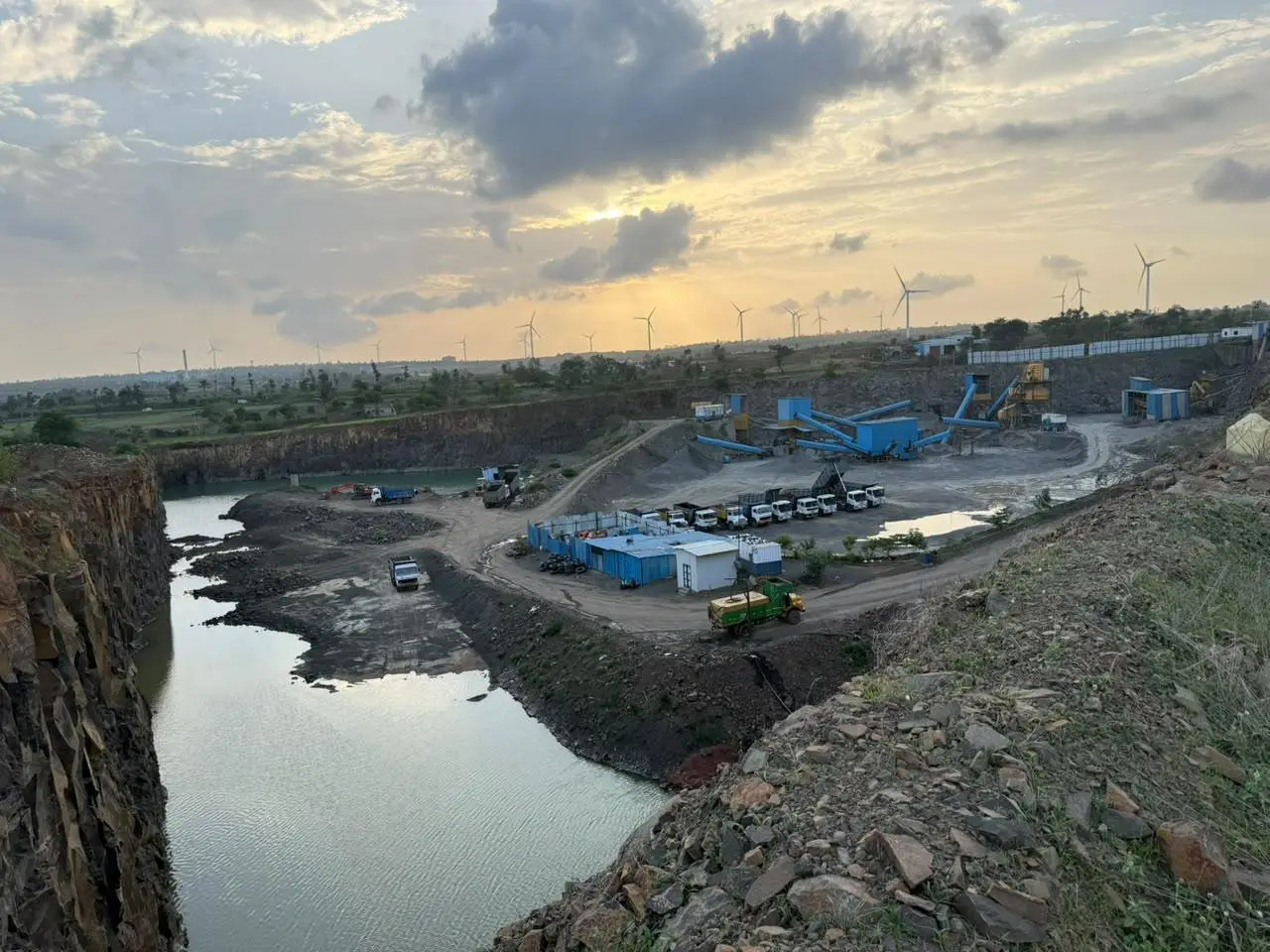
We walk the site before we commit to a date. Four things get looked at: the source rock, the access road, where the plant can physically stand, and the real lead distance from that spot to the road head. The last is rarely the figure on the drawing, because a tipper follows the haul road and not the straight line.
The visit also settles which of our six plants goes. Hard basalt and soft sandstone want different settings and different wear parts, and a package that is mostly GSB loads a plant differently from one that wants a lot of 20mm and 10mm. How the rock type changes the crushing explains why.
The month, week by week
| Week | What happens | What the client needs to have ready |
|---|---|---|
| Before week 1 | Site visit, plant selection, scope and rate agreed | Grading tables, monthly requirement, lease status |
| Week 1 | Plant broken down and loaded. Pad marked out, foundations set out | Land for plant, stockpiles and weighbridge handed over. Access fit for a loaded low-bed |
| Week 2 | Trailers and machines arrive. Foundations cast, feed ramp built | Power or genset decision made. Lease and royalty paperwork in hand |
| Week 3 | Structure raised, crushers and screens set, conveyors and belts fitted, electricals run | Pollution board consent responsibility agreed. Testing lab nominated |
| Week 4 | Commissioning trial, screen decks set to the contract grading, samples tested, weighbridge calibrated, first dispatch | Transit passes working. Road head ready to receive |
The weeks overlap in practice. Foundations are often being cast while the last trailers are still on the road.
Weeks one and two: breakdown and the move
A three-stage plant does not travel as a plant. The primary jaw, the secondary cone, the tertiary stage, the screens, the conveyors and the control panel are separated and loaded onto low-bed trailers, and some of those loads are over-dimensional. The crew that strips the plant is the crew that raises it again, because people who took a machine apart know how it goes back together.
The excavators, the wheel loader and the tippers move in the same fortnight. While the steel is on the road the civil work starts at the new site: the pad is levelled, the foundations are cast and the feed ramp is built. Concrete has to gain strength before a crusher is bolted to it, and adding people does not shorten that. The trailers and permits are covered in moving a crusher plant between states.
Weeks three and four: erection and commissioning
Erection runs in a fixed order: structure, crushers and screens, conveyors, belts, then electricals. On a site with decent access it is about two weeks from the machines landing to material coming off the last belt.
Commissioning is where a plant becomes a supplier. The trial run starts on empty belts and then on feed. The screen decks are set to the grading in your contract, and the crusher settings are adjusted until what falls off each conveyor matches it. Samples are pulled and sent to the lab the contract nominates. Nothing is invoiced before those results are in. A plant that is turning is not yet a plant that is producing to specification.
The weighbridge is calibrated in the same week, because dispatch weight is the billed weight from the first load. Then the tippers start going out, each with a slip.
What has to be ready on the client's side
- Land and access. A level area for the plant, the stockpiles and the weighbridge, and a road a loaded low-bed can use.
- Power or genset. Decide early. A grid connection has its own lead time at the electricity board. A genset gets production started without that wait, and it changes who buys the diesel.
- Lease and royalty paperwork. Most of our crushing is on client-held leases. A plant can be erected beside rock that nobody is yet allowed to move, and it will stand there until the lease is cleared.
- Pollution board consents. The consent to establish and the consent to operate attach to the plant at that location. Agree in writing who applies and who pays. The longer list is in consents and clearances for a crusher plant.
- A nominated lab. Commissioning samples need somewhere to go on the day they are pulled.
What pushes it past a month
Three things, and none of them is the plant. Poor access is the first: a road that cannot take a low-bed means road-making before the first trailer can arrive. A monsoon start is the second. Foundations and steelwork go slower between showers, and a soft pad will not carry a loaded hopper. The third is a lease not yet cleared for working, which stops nothing in the erection programme and everything after it. We say which of these apply before you sign.
From first dispatch to steady production
The first load out is not steady production. The opening days go on settling the plant into the rock: feed rate, crusher settings, a screen cloth changed because one size is running long. After that, one 250 TPH three-stage plant is rated for up to 1,00,000 MT a month on two shifts, with a third shift where the programme needs it. Daily output and dispatch are reported against your requirement, which is part of what a plant run on your site includes.
Demobilisation at the end of the job
When the last layer is down, the sequence runs in reverse. The plant is stripped, loaded and taken away, the site is cleared and handed back. We take our machinery with us, which is not universal in this trade. Two things are worth agreeing at the start instead of the end: what happens to the foundations, and who owns the material left in the stockpiles on the last day.
Standards and sources
- Mobilisation period, plant configuration and monthly output figures: SM Infra's own operating record
- Consent to establish and consent to operate: issued by the State Pollution Control Board for the plant location (no limits quoted here; the board's current conditions govern)
Your contract and its technical schedules override anything written here. Check the clause before you build to it.