
In short
- There is no single best rock for aggregate. The best one is the nearest rock that passes the tests in your contract. Sound basalt and granite usually do. Sandstone and limestone do so deposit by deposit.
- Typical in-situ density runs from 2.2 to 2.5 t/m3 for sandstone up to 2.8 to 3.0 t/m3 for basalt.
- Blasted rock swells. As a planning range take 50 to 70 percent more volume than in the solid, which is a loose density of about 1.5 to 1.8 t/m3.
- Strength mostly decides the drilling and blasting effort. Free silica mostly decides how fast bits, jaw plates and liners wear.
- Bedded and laminated rock tends to break flaky, and soft rock makes more fines.
People ask which rock makes the best aggregate as if there were a league table. There is not. A road is built from the rock that lies within hauling distance, provided it passes the tests the contract sets, and the useful question is what that rock will do to the drill, the blast, the crusher and the product.
The short version: basalt and granite are strong, heavy and hard on machines, and when sound they generally give aggregate that passes highway limits. Sandstone and limestone run from excellent to unusable depending on the deposit, and need their test results looked at before anything else.
The four rocks in numbers
| Rock | In-situ density (t/m3) | Compressive strength, UCS (MPa) | Character |
|---|---|---|---|
| Basalt | 2.8 to 3.0 | 78 to 412 | Volcanic, fine-grained, dense |
| Granite | 2.6 to 2.75 | 100 to 275 | Coarse interlocking crystals, quartz-bearing |
| Sandstone | 2.2 to 2.5 | 50 to 160 | Cemented sand grains, bedded |
| Limestone | 2.5 to 2.7 | 10 to 245 | Mostly calcium carbonate, bedded |
Typical published ranges, with strength from an explosives manufacturer's reference table. Test the rock you intend to work.
Look at the width of the strength ranges before the averages. The strongest limestone in that table is stronger than the weakest basalt. The name of a rock tells you what to expect, not what you have.
Density and swell: tonnes are not cubic metres
Density matters because rock is surveyed by volume at the face and sold by weight at the weighbridge. A cubic metre of solid basalt weighs close to 3 tonnes. The same cubic metre of sandstone may weigh under 2.5.
Then the rock is blasted, and it swells. Broken rock has voids, so it fills more space than it did in the solid. For well-blasted hard rock, plan on roughly 50 to 70 percent swell, with 60 to 65 percent a common figure, which gives a loose density of about 1.5 to 1.8 t/m3 in the muck pile and the tipper body. That is a planning range. The real figure depends on fragmentation, and counting tipper loads against a surveyed blast volume gives you your own. Converting tonnes, cubic metres and brass covers the finished products.
Basalt
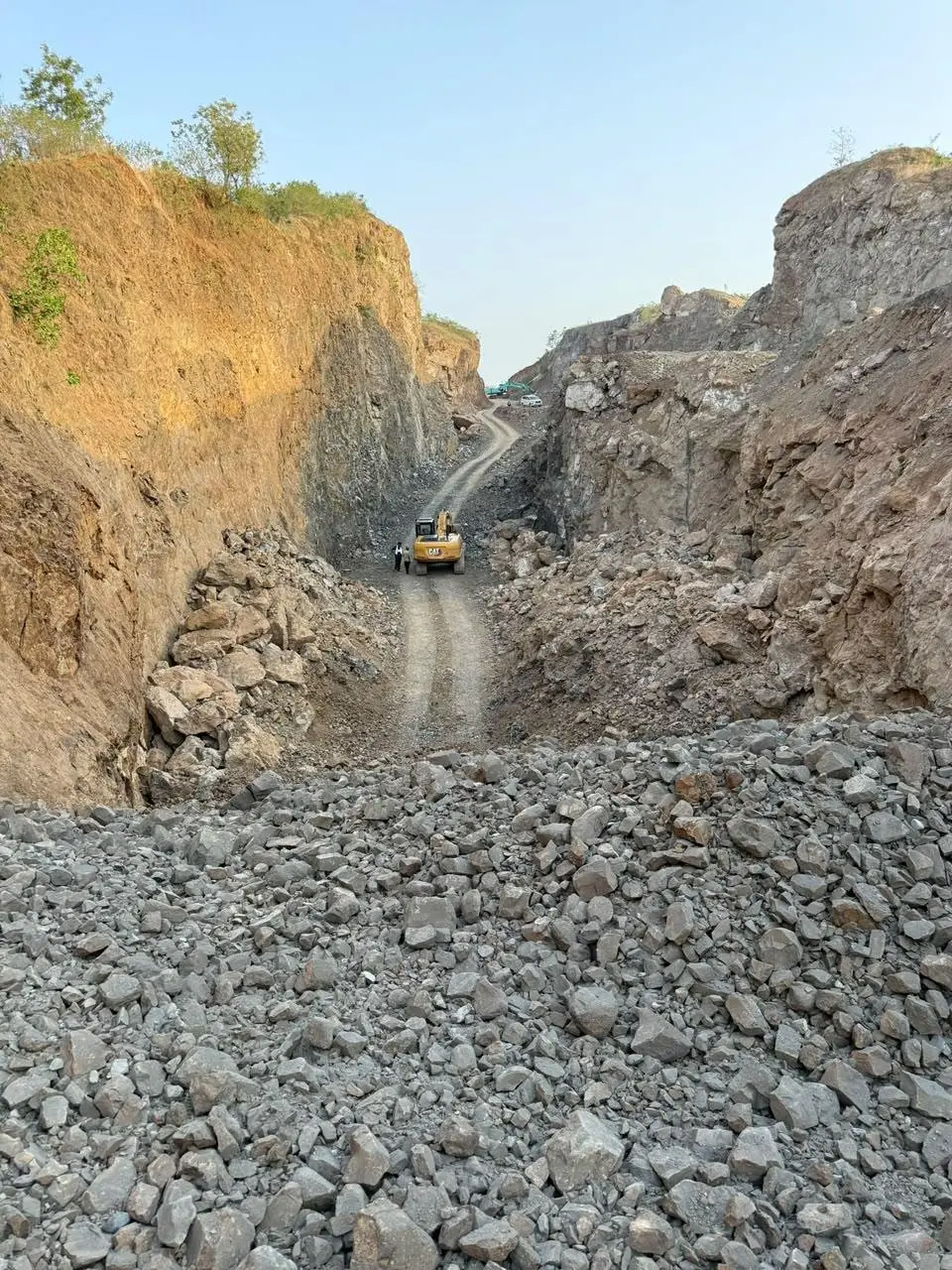
Basalt is the rock of the Deccan: fine-grained, dense, dark and often very strong. The hard flows drill slowly, and at the crusher the rock is tough, so power draw and liner wear are both high. Our crews mined, drilled and blasted hard Deccan basalt on the Samruddhi Mahamarg under Sansar Infra LLP, and we work the same rock in Maharashtra today. Our experience of it fits in one line: heavy on liners, generous on strength.
The product is usually worth the trouble. The cautions are local: weathered bands and layers full of gas holes absorb water and crush weakly, and they have to be kept out of the feed.
Granite
Granite is coarse-grained, built of interlocking crystals, a good part of them quartz. It is strong, though the table shows it is not necessarily stronger than basalt. What sets it apart is what the quartz does to steel. As a general principle, the more free silica a rock carries, the faster it consumes drill bits, jaw plates, liners and screen mesh. We have printed no abrasiveness ranking, because a figure worth using comes from a laboratory test on the actual rock.
On Challakere to Hiriyur in Karnataka our crews worked hard granite, and the project record is blunt about it: different bits, different liners, different penetration rates. What wears on a crusher shows how that appears at the plant.
Sandstone
Sandstone is sand grains held together by a cement, and the cement decides everything. Where it is silica, the rock is strong and, being nearly all quartz, abrasive. Where it is clay or calcite, the rock is soft, drills quickly, crushes easily and makes a lot of fines.
It is also bedded. Rock that splits along bedding or lamination tends to break into slabs, so a flaky product is the standing risk and the last crushing stage has to work for shape. Flakiness and elongation index explains the test. Soft sandstone also makes more fines, which matters in GSB, where too many hold water. We work sandstone through Bundelkhand, where a drill is productive across a full shift in a way it is not in Karnataka granite.
Limestone
Limestone is mostly calcium carbonate, a soft mineral, so as a general tendency it is gentle on bits and liners and easy to drill and crush. It is also the most variable. The table runs from 10 MPa, which is barely rock, to 245.
So limestone aggregate for road construction is a question for the laboratory, not the geology map. Dense, crystalline limestone is laid in highway layers wherever it passes. Soft, chalky or clay-seamed limestone tends to fail on impact and abrasion and makes dust instead of chips. The aggregate tests a highway contract asks for are the filter. Our own project record names basalt, granite, sandstone and hill rock, so on limestone we would want results from the deposit before saying anything.
What changes on site
- Drilling. Strength and structure set the penetration rate, so the same rig makes very different metres per shift in soft sandstone and in hard granite.
- Blasting. Strong, massive rock needs more energy for the same fragmentation. Bedded and jointed rock breaks along its own planes whether the design likes it or not.
- Wear parts. Silica is the driver. Liners are budgeted by the rock, not by the calendar.
- Shape. Bedded or laminated rock tends flaky. It needs a crusher kept full and sometimes a shaping stage.
- Fines. Soft rock makes more dust at every stage: a product if somebody buys it, a yard problem if nobody does.
Why the site visit starts with the rock
On our jobs the first visit looks at the source rock, the access and where a plant can stand, and it decides most of the cost. Which of our six plants goes to site follows from it, because hard basalt and soft sandstone want different settings and different wear parts.
If you hold a lease and are pricing mining and crushing on it, send whatever test results exist, with photographs of the face. If none exist, send samples to a laboratory first. A crushing rate quoted without seeing the rock is a guess with a margin added.
Standards and sources
- Rock solid density and unconfined compressive strength: Dyno Nobel blasting guide (2010), rock properties table
- Swell and loose density of blasted rock: United States Federal Highway Administration, Federal Lands earthwork design guidance, and published bulking-factor tables. Planning ranges only
- Rock worked on named projects, drilling experience and plant selection: SM Infra's own operating record. Work before October 2024 was carried out under Sansar Infra LLP
Your contract and its technical schedules override anything written here. Check the clause before you build to it.