
In short
- Flakiness index is the percentage by weight of particles thinner than 0.6 of their mean dimension. Elongation index is the percentage longer than 1.8 times it. Both tests are in IS 2386 Part 1.
- MoRTH's Fifth Revision limits the combined index to 35% for WMM (Table 400-12), DBM (Table 500-8) and bituminous concrete (Table 500-16). IS 383:2016 allows 40% for concrete aggregate.
- Shape is made in the crushing circuit. Jaw-only product, a starved cone, a wrong closed side setting and worn liners all push the index up.
- The test does not apply below 6.3 mm, so a good result on 20mm says nothing about the dust.
A stockpile of 20mm can pass every sieve in the grading table and still be rejected. A sieve measures one dimension of a stone. A chip three times as long as it is thick goes through the same aperture as a cube, and then snaps under the roller or bridges in the concrete.
The flakiness and elongation indices are how a specification catches that. Flakiness index is the percentage by weight of particles whose thickness is less than 0.6 of their mean dimension. Elongation index is the percentage whose length is more than 1.8 times it. MoRTH limits the two added together to 35% for WMM, DBM and bituminous concrete, and IS 383:2016 allows 40% for concrete aggregate.
What the two indices measure
Both definitions are in IS 2386 Part 1, and both hang on the mean dimension: the average of the two sieve sizes that bound a fraction. For stone passing 10 mm and retained on 6.3 mm the mean dimension is 8.15 mm. A particle in that fraction is flaky if it is thinner than 4.89 mm and elongated if it is longer than 14.7 mm. Those are the slot width and the length cut into the gauges for that fraction.
Neither test applies to material smaller than 6.3 mm. The indices describe your 40mm, 20mm and 10mm. They are silent on the dust.
How the test is run
- Sieve the sample into the standard fractions of IS 2386 Part 1, which run from 63 to 50 mm at the top down to 10 to 6.3 mm. Each fraction tested needs at least 200 pieces.
- Weigh each fraction, then offer every piece to the slot of the thickness gauge for that fraction. What passes through the slot is flaky. Weigh it.
- Flakiness index is the weight that passed the slots as a percentage of the weight gauged.
- For the combined index, set the flaky pieces aside and try the remainder on the length gauge. A piece that will not fit between the pins for its fraction is elongated. Work out the elongation index on that remainder.
- Add the two percentages.
IS 2386 Part 1 describes the two tests separately. MoRTH and IS 383:2016 both specify the combined figure. The two do not give the same number, so check which one the lab report shows before you compare it with a limit.
The limits, layer by layer
| Use | Limit | Where it is written |
|---|---|---|
| Wet mix macadam | 35% max | MoRTH Table 400-12 (Clause 406) |
| Dense bituminous macadam | 35% max | MoRTH Table 500-8 |
| Bituminous concrete | 35% max | MoRTH Table 500-16 |
| Coarse aggregate for concrete | 40% max; the engineer-in-charge may relax it | IS 383:2016 Clause 5.3 |
| Granular sub-base | No shape index in the table | MoRTH Table 400-2 |
MoRTH figures are from the Fifth Revision (2013). Standards get revised and a contract can be tighter than the code, so build to the number in your contract.
For WMM, MoRTH Table 900-3 asks for one combined flakiness and elongation test per 500 m3 of aggregate, against one grading test per 200 m3. Shape is checked less often than grading. A cone that has drifted can put a lot of stone on the road before anybody gauges it.
Why flaky stone fails in the layer
A cubical particle carries load in any direction. A flake carries it well lying flat and badly across its thin section, so under a vibratory roller or a loaded axle it breaks. In WMM a broken flake means fresh fines the grading did not allow for. In a bituminous layer it means two uncoated faces inside the mat, which is where water gets in.
Flakes also pack badly. They bridge and leave voids, or lie flat and slide over each other. Either way the mix needs more binder to fill and coat: more bitumen in DBM and BC, more cement paste and water in concrete for the same workability.
What makes stone flaky
- The rock. Bedded and laminated rock splits along its planes whatever the plant does, and some fine-grained hard rock slivers in a jaw. How the rock changes the crushing goes into this.
- Jaw-only crushing. A jaw squeezes rock between two plates and the product comes out slabby. It is a primary crusher, and its product is not finished chips.
- A closed side setting that does not match the product. A cone gives its best shape in the sizes close to its setting. Ask it for 10mm with the setting opened up for tonnage and the 10mm fraction is the flaky leftovers.
- A starved cone. Choke fed, with the chamber full, stone breaks against stone. Trickle fed, each piece is nipped once between mantle and concave and leaves as a flake.
- Worn liners. The chamber profile changes and the real setting drifts away from the one on the gauge.
What fixes it in the plant
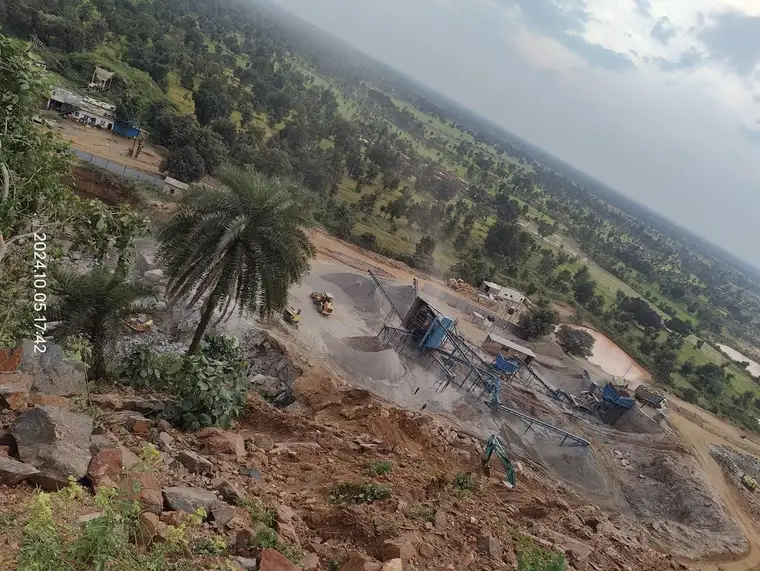
Stages, first. Our plants run a primary jaw, a secondary cone and a tertiary stage ahead of the screens, so that no single crusher is asked for the whole reduction from boulder to 10mm. What each stage of a three-stage plant does explains the split.
Where shape is the complaint, the usual tertiary machine is a vertical shaft impactor. Its rotor throws stone against a rock lining or anvils, the pieces break along their natural fractures, and particle-on-particle attrition knocks the thin edges off. Rock-on-rock running gives the best shape and the least reduction, so part of the product goes round again.
The rest is operating discipline: a surge of feed ahead of the cone so it stays choked, the setting checked against the product, liners changed on wear and not on failure. If one size is still marginal, a tighter bottom cut can take out the fraction where the flakes collect and send it round again. That costs chip yield and makes more dust, which is the price of shape in stone crushing to a specification.
What to ask a supplier
- The combined index for each size you are buying, not one figure for the plant. The smaller chips are usually the flakier ones.
- The date of the test, and when the cone liners were last changed. A result taken on fresh liners tells you little about the third month.
- How many crushing stages the stone has been through, and whether the cone runs choke fed.
- Which face the rock is coming from. Shape moves when the face moves into different bedding.
On our plants, samples are pulled at commissioning and through the run and go to the lab your contract nominates. Ask for the combined index on that report next to the grading. The materials page lists the sizes we produce, and the other aggregate tests for highway work covers impact value, abrasion and absorption, which no crusher setting can change.
Standards and sources
- IS 2386 (Part 1):1963, particle size and shape: Clauses 4 and 5 (flakiness index and elongation index)
- MoRTH Specifications for Road and Bridge Works, Fifth Revision (2013): Table 400-2, Table 400-12 (Clause 406), Table 500-8, Table 500-16 and Table 900-3
- IS 383:2016, Coarse and Fine Aggregate for Concrete (Third Revision), Clause 5.3
- Plant configuration and sampling practice: SM Infra's own operating record
Your contract and its technical schedules override anything written here. Check the clause before you build to it.