
In short
- The primary jaw takes run-of-quarry rock and sets the top size. The secondary cone does most of the reduction. The tertiary stage, a cone or a VSI, makes the finished sizes and the shape.
- Each machine breaks rock cleanly only inside a limited reduction ratio: typically 4:1 to 6:1 for a jaw, 6:1 to 8:1 for a secondary cone, 4:1 to 6:1 for a tertiary cone and about 2:1 to 5:1 for a VSI.
- A VSI breaks rock by impact and stone-on-stone attrition, which knocks the edges off flaky pieces. It shapes more than it reduces.
- Screens in closed circuit return oversize to the crusher, so the mesh fixes a product's top size. The closed side setting is the crusher's main adjustment.
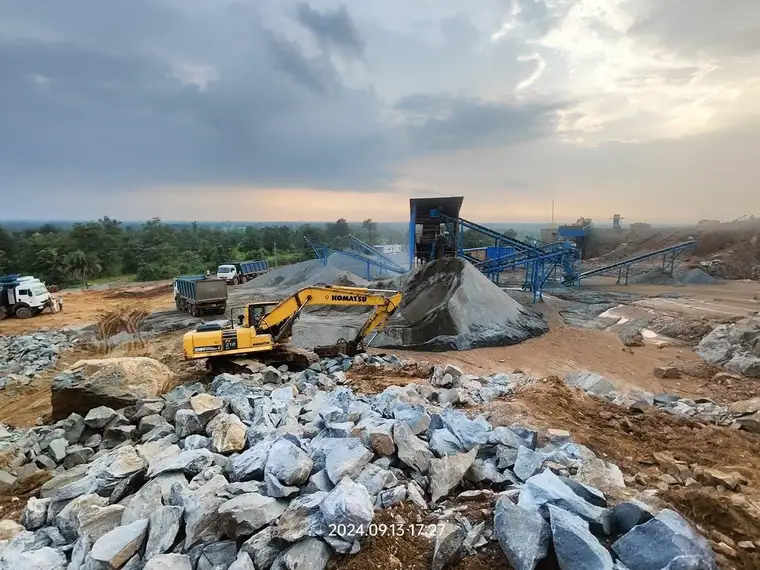
A site engineer seeing a crusher plant for the first time finds a jaw, one or two cones, several screens and a tangle of conveyors, and reasonably asks why one large machine could not do the job. The answer is reduction ratio. No crusher takes a boulder to 10 mm chips in one pass without wasting much of the stone as dust.
So the work is divided. The primary jaw brings run-of-quarry rock down to a size a cone can swallow. The secondary cone does most of the reduction. The tertiary stage, a fine cone or a vertical shaft impactor (VSI), makes the finished sizes and decides the particle shape. Screens sort the product and send oversize back round.
Why crushing is done in stages
Reduction ratio is feed size divided by product size. Every crusher has a range in which it breaks rock cleanly. Push it past that and it chokes, eats its liners, or produces a heap of fines with a few flaky survivors. The figures below are typical ranges from manufacturer and trade references, not from a standard. The supplier's data sheet and a trial on your own rock decide.
| Crusher | Typical reduction ratio | Comment |
|---|---|---|
| Jaw (primary) | 4:1 to 6:1 | Some references quote 8:1 or more |
| Cone (secondary) | 6:1 to 8:1 | Some sources put it at 3:1 to 5:1 |
| Short-head cone (tertiary) | 4:1 to 6:1 | Finer chamber, lower ratio |
| VSI (tertiary) | About 2:1 to 5:1 | Rock-on-rock machines sit low |
The primary jaw sets the top size
A jaw crusher is a compression machine. Rock falls into a V-shaped chamber between a fixed plate and a moving one, is squeezed until it breaks, and drops until it is small enough to pass the gap at the bottom. It is slow, heavy and tolerant, which the first stage needs.
The feed opening decides the biggest boulder the plant accepts, so the jaw is really sized by the blast, and anything larger has to be broken at the face. How fragmentation feeds through to crusher output covers that link. A grizzly ahead of the jaw lets small rock bypass it and scalps off soil and clay.
The secondary cone does the bulk of the work
A cone also crushes by compression, but continuously. A mantle gyrates inside a fixed bowl liner, the concave, and rock is nipped several times on its way down the narrowing chamber. It gives a more even product than a jaw and holds a higher reduction ratio, which is why the secondary carries most of the size reduction. Cones dislike a trickle feed. Run half-empty, the product turns flaky and the liners wear in one band.
The tertiary stage makes the product
The third stage makes the sizes that are sold: 20 mm and 10 mm chips and the finer fractions. A tertiary cone, often called a short-head, is the same kind of machine with a finer chamber.
A VSI works differently. A rotor flings the rock against a rock-lined chamber or steel anvils, and it breaks by impact along its natural fracture planes while the pieces grind against each other. That attrition knocks the edges off flaky and elongated particles and leaves a more cubical chip.
The price is reduction. A VSI is expected to manage about 2:1 to 5:1, and one manufacturer's guide notes that a rock-on-rock machine may need up to about 30 percent of its discharge sent round again. Whether a plant needs one depends on the rock and on the flakiness and elongation limit in the contract.
Screens and the closed circuit
Crushers break rock. Screens decide what is product. A vibrating screen carries two or three decks of mesh and splits the stream into oversize, the wanted fractions and fines. In open circuit, whatever the crusher discharges goes forward. In closed circuit, the oversize goes back to the crusher.
Closed circuit is what lets a plant promise a top size: the crusher setting controls how much comes back, but the mesh controls what gets out. It is also why a change of specified grading is mostly a change of decks, which on our plants is a shift of work. Reading a sieve analysis shows how the result is checked.
What closed side setting means
On a jaw or a cone the gap between the crushing surfaces opens and closes with every stroke. The closed side setting, or CSS, is that gap at its narrowest. Tighten it and the product gets finer, throughput falls and liner wear rises.
The CSS is not the top size of the product, because a slabby piece passes the gap on its thin dimension. And the setting drifts: as jaw plates and cone liners wear, the gap opens and the product coarsens until somebody resets it. What wears on a crusher goes into that. A typical CSS figure belongs to the machine's data sheet, so we print none.
The three stages side by side
| Stage | Machine | Feed | Product | What it controls |
|---|---|---|---|---|
| Primary | Jaw crusher | Run-of-quarry shot rock | Coarse crushed rock | Largest boulder accepted; top size going forward |
| Secondary | Cone crusher | Jaw product | Mid-size rock; coarse fractions for GSB and 40 mm | Most of the reduction |
| Tertiary | Short-head cone or VSI | Secondary product and returned oversize | 20 mm and 10 mm chips, fine fractions, dust | Final grading and particle shape |
| Screening | Vibrating screens | Discharge from each stage | Sized stockpiles; oversize returned | Top size of each product |
How the stages map to the products
GSB to MoRTH Clause 401 is a widely graded blend, drawn largely from the coarser end of the plant with fines added back as the specified grading needs. WMM to Clause 406 is blended from several fractions and leans harder on the tertiary stage. Single-size 40 mm comes off after the secondary. The 20 mm and 10 mm chips come off the last stage, where shape matters most. Crusher dust passes the bottom deck at every stage and is a product in its own right.
Our six plants are built this way: primary jaw, secondary cone, a tertiary stage and screening, at 250 to 350 TPH. Which one goes to a site depends on the rock, because hard basalt and soft sandstone want different settings and different wear parts. If you are pricing crushing on your own site or lease, bring the grading table and the split between products to the first call.
Standards and sources
- Crusher reduction ratio ranges: 911 Metallurgist reference on crusher reduction ratios, Stedman Machine Company's VSI primer and the Pit & Quarry University handbook. Trade and manufacturer sources, indicative only
- MoRTH Specifications for Road and Bridge Works, Fifth Revision (2013), Clause 401 (Granular Sub-base) and Clause 406 (Wet Mix Macadam)
- Plant configuration, capacity and deck changes: SM Infra's own operating record
Your contract and its technical schedules override anything written here. Check the clause before you build to it.