
In short
- Fragmentation is the first stage of crushing. What the blast leaves decides how hard the excavator, the breaker and the primary jaw have to work for every tonne.
- Oversize is paid for twice: secondary breaking at the face, and lost feed at the hopper.
- Powder factor is kilograms of explosive per cubic metre of rock. Textbook ranges run from about 0.15 kg in very soft rock to 0.8 kg in hard rock, and the rock and a trial decide the real figure.
- Pattern, hole straightness, delay timing, jointing and stemming move fragmentation more than adding explosive does.
- Too fine is also a cost: more drilling and explosive per tonne, and more dust than the product mix can sell.
The blast decides what the crusher produces because it does the first and largest size reduction on site, from solid rock to pieces an excavator can lift. Whatever it does badly, the plant has to finish with a breaker, a jaw and wear steel, all of which cost more per tonne than explosive does.
A plant fed evenly broken rock holds its monthly tonnage. The same plant fed boulders spends part of every shift waiting. What follows is for the people who pay for both ends of that chain and want to know what to look for at the face.
The blast is the first stage of crushing
Follow a tonne of rock. It is broken by the blast, sometimes again by a hydraulic breaker, then by the primary jaw, the secondary cone and the tertiary stage. What each stage of a three-stage plant does covers the mechanical part. The first step uses chemical energy placed inside the rock. Every later step uses diesel or electricity, and steel that wears.
So saving on drilling and explosive is rarely a saving. An under-charged or badly distributed shot leaves a toe and oversize that cost more to deal with at the hopper than the explosive saved. Blast design and stone crushing are one process with one cost, even when two different firms invoice for them.
What the primary jaw wants
A jaw crusher takes whatever fits its feed opening and no more. A boulder that spans the opening bridges it: the feed stops, somebody has to break or lift the rock out, and the cone and screens run empty meanwhile. Our three-stage plants take a boulder of about 700 mm down to 10 mm chips. The feed opening of the jaw on your plant is on its data sheet, and that figure is the top size the blast has to work to.
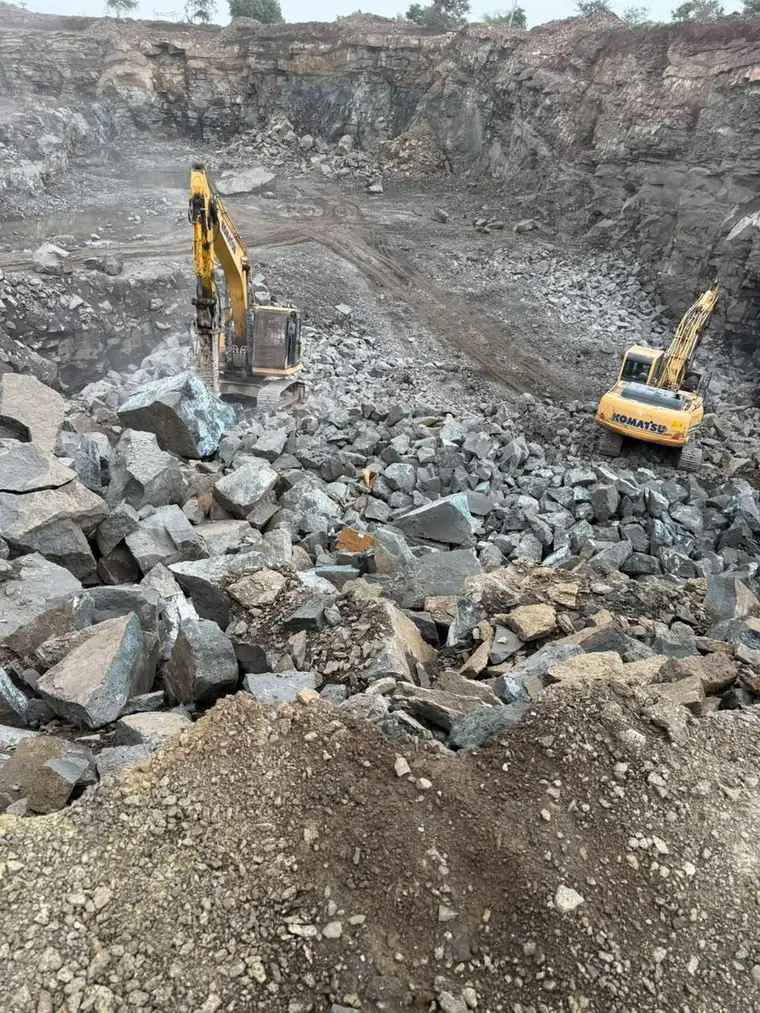
Every piece above it is paid for twice. First at the face, under a breaker. Then at the hopper, in tippers queued and feed lost. A quarry floor littered with boulders set aside for the breaker is a blast design problem on display.
Powder factor and the textbook ranges
Powder factor is the weight of explosive used per cubic metre of rock broken, in kg per cubic metre. It is the number most often quoted about a blast and the one most often misread, because it describes how much energy went in and says nothing about where it went.
| Rock class | Powder factor, kg/m³ |
|---|---|
| Hard | 0.7-0.8 |
| Medium | 0.4-0.5 |
| Soft | 0.25-0.35 |
| Very soft | 0.15-0.25 |
From the Dyno Nobel Blasting and Explosives Quick Reference Guide (2010), which offers its figures as a first estimate in the absence of better data. These are textbook ranges for orientation, not a design. The licensed shotfirer sets the charge for the bench.
Where a particular rock sits is settled by a trial blast, not by its name on the geology sheet. And two shots at the same powder factor can break very differently. Raising it is the lazy answer to oversize, and it brings more vibration and more risk of flyrock with it.
What moves fragmentation
- The pattern. Burden and spacing decide how evenly the energy is spread through the rock. Textbook first estimates put burden at 25 to 40 hole diameters, and the ratio of bench height to burden at 2 to 3.5 for good fragmentation. Burden, spacing, depth and sub-drilling works through them.
- Hole straightness. A hole that wanders leaves too much rock on one side and too little on the other: boulders in one part of the muckpile and fines in another, from a pattern that looked right on paper. See how hole deviation becomes oversize.
- Delay timing. Rock breaks best when each hole fires into space the previous one has just opened. Delays are where fragmentation is won, and a sequence copied from the last bench is a guess.
- Jointing. Rock comes apart along its natural joints first. Where the blocks between joints are larger than the hole spacing, some come out whole whatever the charge.
- Stemming. The top of the hole carries no explosive, so the collar zone is where boulders are commonest. Too much stemming grows that zone; too little vents the gas.
Rock changes all five. Our crews worked hard Deccan basalt on the Samruddhi Mahamarg and hard granite on Challakere to Hiriyur, both under Sansar Infra LLP, and sandstone through Bundelkhand. Fragmentation differed on every one.
Too fine is also a cost
A muckpile with no oversize at all is not automatically a good one. Closer holes and heavier charges cost more per tonne, and over-broken rock arrives at the plant with fines already in it. The crushers add their own. A road takes GSB, WMM and 40, 20 and 10 mm chips in the quantities its design fixes, and crusher dust beyond what the specification and the market will take is a stockpile to be managed.
The target sits between the two failures: the largest piece is one the jaw swallows without help, and the smallest fraction is no more dust than you can sell.
How to judge a muckpile
- Uniformity. Similar sizes from the front of the pile to the back and from one end of the shot to the other. A patch of coarse rock marks a place where the pattern or the holes went wrong.
- Oversize count. The number of boulders set aside for the breaker after each shot. One number, cheap to keep, and it trends.
- The toe. A hump of unbroken rock at floor level means the bottom of the holes did not do their work, and the next bench starts on a bad floor.
- Digging rate. An excavator that fills its bucket in one pass and keeps the tippers turning is the best fragmentation gauge on site. One that rakes and sorts is telling you about the blast.
One crew for the hole and the charge
When one contractor drills, a second charges and a third runs the plant, oversize has three explanations and no owner. Most clients find it simpler to have one crew responsible for the hole and the charge that goes in it.
That is how we work where we run the whole chain. The drilling is done on our own ten machines, the shots are designed and fired by the licensed shotfirers in our blasting crews, and the same firm answers for the tonnage off the last belt. The pattern is then designed for the fragmentation the crusher wants, because the people who drew it also feed the hopper.
Standards and sources
- Dyno Nobel, Blasting and Explosives Quick Reference Guide (2010): powder factors for mass blasts, burden and stiffness-ratio first estimates
- Plant configuration, feed size, fleet and project record: SM Infra's own operating record
Your contract and its technical schedules override anything written here. Check the clause before you build to it.