
In short
- Crusher dust is the unprocessed fines from a crushing plant's bottom screen deck. M-sand, in trade usage, is crushed rock that has been shaped, graded and washed or classified to meet a sand specification. River sand is natural sand.
- IS 383:2016 calls processed crushed rock sand 'crushed sand', and its foreword says crusher dust cannot be called that unless it is processed to meet the standard. In the code, 'manufactured sand' means fine aggregate from non-natural sources such as slag.
- Table 2 of the code allows up to 15% of material finer than 75 micron in crushed sand, against 3% in natural sand.
- Plain crusher dust has proper uses: paver bedding, filling and levelling, block making, and the fine fraction of GSB and WMM.
On most sites the three words are used as if they were grades of one material. The purchase order says M-sand, the tipper brings crusher dust, and nobody notices until the cube results come back.
They are three different things. River sand is natural sand, worn round by water. Crusher dust is whatever passes the finest screen on a crushing plant, with no control over its grading or its fines. M-sand, as the trade uses the word, is crushed rock processed further so that it meets the fine aggregate requirements of IS 383. The code calls that product crushed sand and keeps the word manufactured for something else.
How each one is made
River sand is dug from a river bed or its flood plain. The river has done the processing already: grains rounded by rolling, most of the silt carried away. Most, not all, and its grading is whatever that stretch of river left behind.
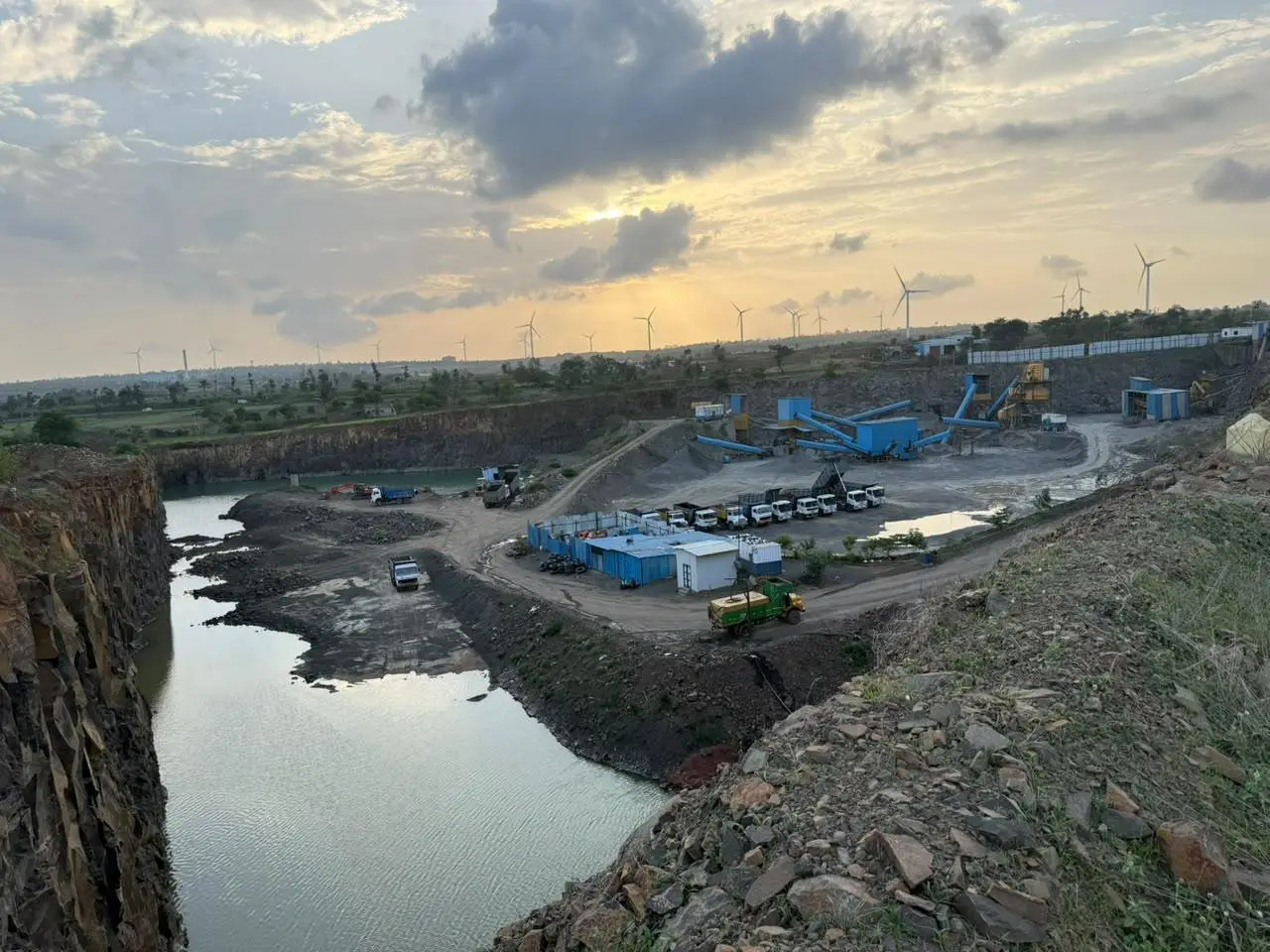
Crusher dust is a by-product. On a three-stage plant the crushed rock passes over screen decks that cut 40mm, 20mm and 10mm, and everything that falls through the bottom deck lands on the dust belt. It carries the fine powder from every crushing stage. Stone dust and quarry dust are other names for it.
M-sand is made on purpose. The feed, usually small chips, goes through a shaping crusher, normally a vertical shaft impactor, which throws stone against stone or against anvils so that the grains break along their natural fractures and lose their thin edges. The product is screened to a top size and a grading, and the excess fines are taken out by washing or by dry air classification. What each stage of a crushing plant does covers the machines.
What IS 383 calls them
- Crushed sand (Clause 3.1.2): crushed stone sand, made by crushing hard stone, or crushed gravel sand. This is what the trade sells as M-sand.
- Mixed sand (Clause 3.1.3): a blend of natural sand with crushed stone sand or crushed gravel sand.
- Manufactured fine aggregate, or manufactured sand (Clause 3.1.4): fine aggregate from sources other than natural ones, such as slag and recycled concrete aggregate. Not crushed rock.
So a supplier who says M-sand means the code's crushed sand, while a specification that says manufactured sand, read literally, means slag or recycled aggregate. Our own materials list uses the trade word, as most of the industry does. In a purchase order, write 'crushed sand conforming to IS 383:2016' with the grading zone, and nobody has to guess.
The foreword of the code deals with dust directly. Crusher dust or quarry dust produced from fine screening, it says, "cannot be called crushed sand" unless it has been processed to meet the standard.
Grading zones and the fines limit
IS 383:2016 Table 9 sorts fine aggregate into four grading zones, Zone I the coarsest and Zone IV the finest. The 600 micron sieve separates them most clearly: 15 to 34% passing for Zone I, 35 to 59% for Zone II, 60 to 79% for Zone III and 80 to 100% for Zone IV. Crushed sand has to fall inside a zone like any other sand, with one allowance in Note 1: for crushed stone sands the limit on the 150 micron sieve is raised to 20%.
The other number that matters is in Table 2. Material finer than 75 micron is limited to 3% in uncrushed natural sand, 15% in crushed sand and 12% in mixed sand. The usual reasoning for the higher figure is that crusher fines are ground rock, not clay. That only holds if the overburden was stripped clean. Reading a sieve analysis shows how to check a result against a zone.
Why unprocessed dust is not sand
- Fines. Nothing has removed the powder. The share finer than 75 micron is uncontrolled, and it changes with the rock and the liner wear.
- Shape. Dust off a cone is angular and often flaky. Sharp, flat grains need more water to move past each other, and more water means more cement for the same strength.
- Grading. No deck controls it. One week the dust is coarse, the next fine, depending on which products the plant is making. A mix designed on Monday's sample does not suit Thursday's load.
So dust goes into concrete only when that stockpile has been tested inside IS 383 and the mix designed with it.
Where plain crusher dust belongs
- Bedding under paver blocks.
- Filling and levelling.
- Block and brick manufacture, where the maker designs the mix around the dust he is getting.
- The fine fraction of GSB and WMM, which need fines to compact. MoRTH Table 400-13 allows no more than 5% passing 75 micron in WMM, and Clause 406 limits the plasticity index of the material finer than 425 micron to 6, so the dust has to be non-plastic.
- Fine aggregate for DBM and BC, where MoRTH Section 500 asks for a sand equivalent of at least 50 and a plasticity index of 4 or less on the fraction passing 0.425 mm. Dust carrying overburden will not meet that.
The three side by side
| Property | Crusher dust | Crushed sand (M-sand) | River sand |
|---|---|---|---|
| How it is made | By-product, off the bottom deck | Crushed rock, shaped and graded on purpose | Dug from a natural deposit |
| Name in IS 383:2016 | Not crushed sand, per the foreword | Crushed sand, Clause 3.1.2 | Uncrushed natural sand |
| Finer than 75 micron (Table 2) | Uncontrolled | 15% max | 3% max |
| Grading | Whatever the plant made that shift | Screened to a zone of Table 9 | As the deposit gives it |
| Grain shape | Angular, often flaky | Angular to cubical | Rounded |
| Proper use | Bedding, filling, blocks, fines in GSB and WMM | Concrete, where the specification accepts it | Concrete, mortar and plaster |
Limits from IS 383:2016. Standards get revised and the contract governs.
Why the distinction matters more each year
River sand gets harder to obtain every year, and a legal source is often a long lead from the site. Hard rock is not short, and every crushing plant makes fines whether anybody wants them or not. On our plants dust is a product, not a waste heap: sold where the specification allows it, it keeps the yard clear and the rate down.
Shortage blurs the words, so say what the fines are for when you order. For bedding and filling, ask for crusher dust by the tonne. For concrete, ask for crushed sand to IS 383:2016, name the zone, and ask for the test report on grading and on material finer than 75 micron. Stone crushing on our plants produces dust alongside the chips, the materials page lists it, and which size of aggregate goes where covers the coarse fractions it is batched with.
Standards and sources
- IS 383:2016, Coarse and Fine Aggregate for Concrete (Third Revision): foreword, Clauses 3.1.2 to 3.1.4, Table 2 and Table 9 with Note 1
- MoRTH Specifications for Road and Bridge Works, Fifth Revision (2013): Clause 406 and Table 400-13 (WMM), Section 500 fine aggregate requirements for DBM and BC
- Product list and plant configuration: SM Infra's own operating record
Your contract and its technical schedules override anything written here. Check the clause before you build to it.