
In short
- Impact value, Los Angeles abrasion and crushing value measure the strength of the rock itself, and all three are in IS 2386 Part 4. Water absorption is in Part 3.
- MoRTH's Fifth Revision accepts abrasion or impact value: 40% or 30% for WMM, 35% or 27% for DBM, 30% or 24% for bituminous concrete.
- Water absorption is capped at 2% for DBM and BC. In WMM and GSB, going over 2% does not reject the stone but triggers a further test.
- IS 383:2016 limits crushing value to 30% for concrete wearing surfaces. The 2016 code has no 45% figure for other concrete: above 30%, the ten percent fines test applies, minimum load 50 kN.
A failing grading can be put right in a shift by changing a screen deck. A failing impact value cannot be put right at all. It was settled when the rock formed, and the only cure is a different face or a different quarry.
Impact value, Los Angeles abrasion, crushing value and water absorption describe the rock, and MoRTH and IS 383 put a ceiling on each for the layer the stone is going into. On the road layers the impact value limits are 30% for WMM, 27% for DBM and 24% for bituminous concrete, with abrasion as the alternative test and 2% water absorption on the bituminous courses.
What each test measures
- Aggregate impact value (AIV). The percentage of fines produced when a sample is struck repeatedly by a falling hammer. It measures toughness, the resistance to sudden shock. IS 2386 Part 4.
- Los Angeles abrasion value. The percentage worn down to fines when the sample is tumbled in a steel drum with a charge of steel balls. It combines rubbing and impact. IS 2386 Part 4.
- Aggregate crushing value (ACV). The percentage of fines produced under a slowly applied compressive load. The same part gives the ten percent fines test, which reports the load needed to produce ten percent fines. IS 2386 Part 4.
- Water absorption. The water the stone takes into its pores, as a percentage of its dry weight. A high figure points to porous or weathered rock. IS 2386 Part 3.
In the three strength tests a lower number is better stone. Ten percent fines is the exception: it reports a load, and higher is better.
MoRTH limits for WMM, DBM and BC
| Test | What it tells you | Limit for WMM | Limit for DBM | Limit for BC | Method |
|---|---|---|---|---|---|
| Aggregate impact value | Toughness under shock | 30% max | 27% max | 24% max | IS 2386 Part 4 |
| Los Angeles abrasion | Resistance to wear | 40% max | 35% max | 30% max | IS 2386 Part 4 |
| Aggregate crushing value | Strength under slow load | See contract | See contract | See contract | IS 2386 Part 4 |
| Water absorption | Porosity, weathering | Over 2%: soundness test | 2% max | 2% max | IS 2386 Part 3 |
| Combined flakiness and elongation | Particle shape | 35% max | 35% max | 35% max | IS 2386 Part 1 |
| Soundness, sodium / magnesium sulphate | Resistance to weathering | See contract | 12% / 18% max | 12% / 18% max | IS 2386 Part 5 |
MoRTH Specifications for Road and Bridge Works, Fifth Revision (2013): Table 400-12 for WMM, Table 500-8 for DBM, Table 500-16 for BC. Standards get revised and the contract governs.
Two things in that table get misread. Abrasion and impact value are joined by the word 'or': a source that passes on one does not also have to pass on the other unless the contract asks for both. And crushing value does not appear in these three MoRTH tables. It reaches a highway job through IS 383, when the same quarry feeds the batching plant.
Granular sub-base is the tolerant layer. MoRTH Table 400-2 allows an impact value of up to 40. Where water absorption is above 2%, Clause 401.2.2 asks for the wet aggregate impact value to IS 5640, because some stone that is tough when dry softens when soaked. The grading side of that layer is in GSB under MoRTH Clause 401.
Soundness, stripping and polished stone value
Soundness (IS 2386 Part 5) cycles the stone through a sulphate bath to imitate weathering; DBM and BC allow a loss of 12% with sodium sulphate or 18% with magnesium sulphate. Stripping (IS 6241) checks that bitumen stays on the stone under water, and at least 95% of the coating has to be retained. Polished stone value applies to BC only, at a minimum of 55 tested to BS 812-114, because the wearing course has to keep its skid resistance.
IS 383 limits for concrete aggregate
| Property | Wearing surfaces | Other concrete |
|---|---|---|
| Aggregate crushing value (Clause 5.4.1) | 30% max | Above 30%: ten percent fines test, 50 kN min |
| Aggregate impact value (Clause 5.4.2) | 30% max | 45% max |
| Los Angeles abrasion (Clause 5.4.3) | 30% max | 50% max |
Impact value is the alternative to crushing value. For concrete of grade M65 and above, crushing value and impact value are each limited to 22%.
Wearing surfaces means runways, roads and pavements, so pavement quality concrete sits in the stricter column. The crushing value row trips people up. Older notes still quote 45% for concrete other than wearing surfaces. The 2016 code does not print that figure. Where crushing value comes out above 30%, it sends you to the ten percent fines test, and the load has to be at least 50 kN.
The rock's results and the plant's results
Impact value, abrasion, crushing value, absorption, soundness and polished stone value come from the mineral and how weathered it is. Grading, particle shape and cleanliness come from the crushers and screens. The first group is decided by where the excavator is digging. The second can be corrected at the plant, and the flakiness and elongation index is the clearest example.
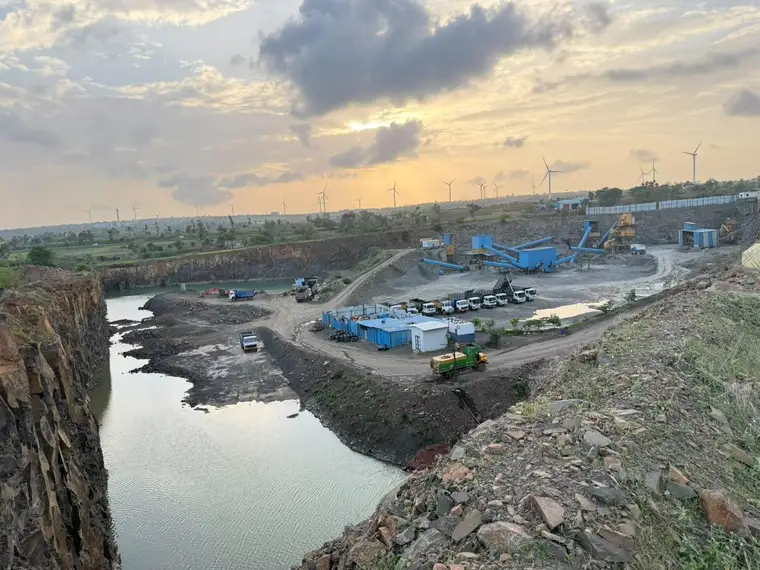
The quarry still has some control over the first group. Weathered cap rock and soft bands can be kept out of the feed, and overburden stripped clean so that clay does not ride in on the stone. That is mining work. Strong rock has its own price: the hard Deccan basalt we crush on the Nanded to Jalna expressway is generous on strength and heavy on liners.
How often to test
For WMM, MoRTH Table 900-3 sets minimum frequencies of one impact value test per 1,000 m3 of aggregate, one combined flakiness and elongation test per 500 m3 and one grading per 200 m3. The rock's property is checked least often because it changes slowest. The plant's properties are checked most often because they can change in a shift.
That logic fails when the face moves. If the bench advances into a weathered zone or a different band, test the strength and absorption again that week.
Why we sample at commissioning and through the run
At commissioning the question is whether this rock, through this plant, at these settings, meets the contract. Samples are pulled before anything is invoiced and go to whichever lab the contract nominates. Through the run the question is whether anything has moved: the face, a blinded screen, a worn liner. We would rather find that ourselves than have your quality engineer find it in a layer already down.
On a new source, get impact value, abrasion and absorption on a representative sample first. If those pass, the crushing can be set up to deliver the rest, and reading a sieve analysis covers the result you will see most often after that.
Standards and sources
- MoRTH Specifications for Road and Bridge Works, Fifth Revision (2013): Table 400-2 and Clause 401.2.2 (GSB), Table 400-12 (WMM), Table 500-8 (DBM), Table 500-16 (BC), Table 900-3 (test frequencies)
- IS 383:2016, Coarse and Fine Aggregate for Concrete (Third Revision), Clauses 5.4.1 to 5.4.3
- IS 2386 Parts 1, 3, 4 and 5; IS 5640 (wet aggregate impact value); IS 6241 (stripping); BS 812-114 (polished stone value)
- Sampling practice and project rock types: SM Infra's own operating record
Your contract and its technical schedules override anything written here. Check the clause before you build to it.