
In short
- There is no standard rate per metre. The rate follows penetration rate and bit life, and both depend on the rock and the hole diameter at your site.
- What matters to a project is the cost per cubic metre or per tonne of rock broken. A cheap metre on a tight pattern can cost more than a dearer metre on a wide one.
- On a 9 m bench, opening the pattern from 2.5 m × 3.0 m to 3.0 m × 3.5 m cuts drilling from about 0.15 m to about 0.11 m in every cubic metre, if the rock allows it.
- Drilling alone suits a rate per metre, drilling with blasting a rate per cubic metre of solid rock, and a quarry feeding a plant a rate per tonne.
The enquiry usually arrives as one line: what is your rate per metre for rock drilling. It is a reasonable thing to want and an impossible thing to answer from a desk. Anyone who answers it instantly has either priced in the worst rock they have met, or has not thought about yours.
The rate depends almost entirely on the rock and the hole diameter, which is why nobody honest quotes a fixed metre rate before seeing the site. What can be explained in advance is what moves the number and which of those things you control. No prices appear below: any we printed would be wrong for your district and out of date within a quarter.
Rock: penetration rate and bit life
A drilling crew's costs run by the hour: rig, compressor, diesel, operator and helper. Its income runs by the metre. So the rate is roughly the cost of an hour divided by the metres drilled in it, plus the bits and rods used up. Hard rock cuts the metres. Abrasive rock eats the steel.
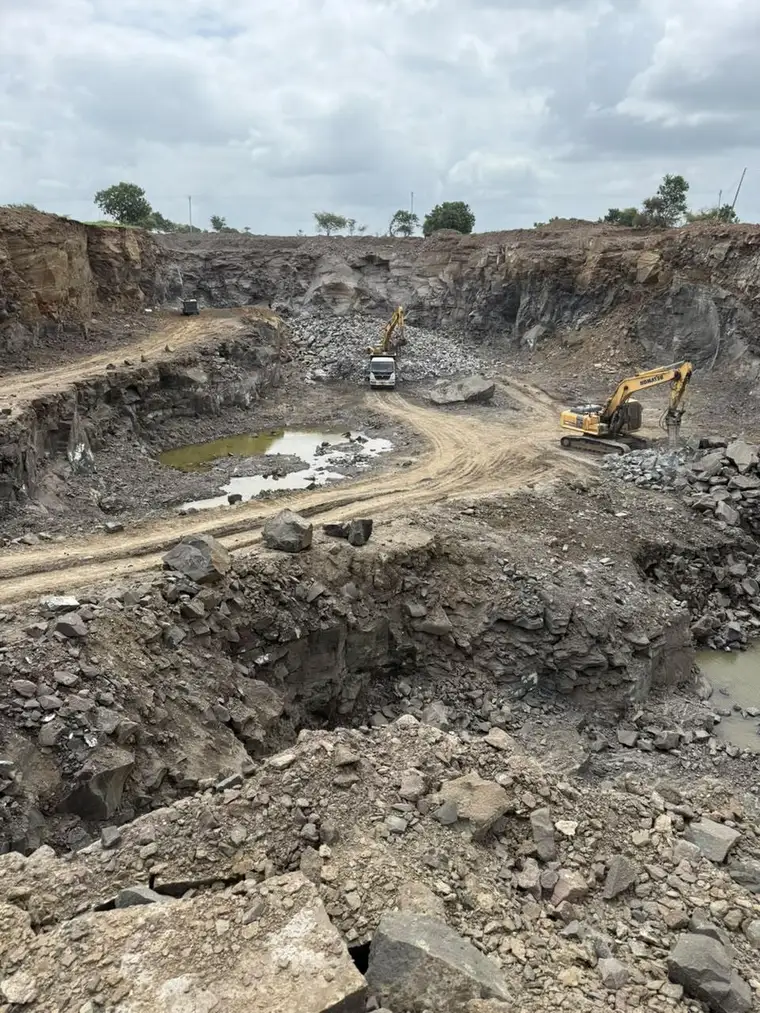
Rock names help less than buyers expect. One published table gives compressive strengths of 78 to 412 MPa for basalt, so the word on an enquiry could mean either end of that. On the sandstone and softer basalt we work through Bundelkhand and Madhya Pradesh, a machine is productive across a full shift. The hard granite our crews drilled on the Challakere to Hiriyur road in Karnataka, under Sansar Infra LLP, was a different number. How the rock changes the work carries the point on to the crusher.
Hole diameter and depth
A larger hole removes more rock for every metre drilled, so it is slower and needs more air and a heavier rig. It also breaks more rock per hole, because burden and spacing scale with diameter. Depth works differently: every rod change is time not spent drilling. That makes the choice between DTH, top hammer and wagon drill a cost decision as much as a technical one.
Pattern and specific drilling
Specific drilling is the length of hole drilled for each cubic metre of solid rock broken. It is the link between a rate per metre and what the rock costs you, and the pattern fixes it. Wider patterns mean fewer metres in every cubic metre.
Those figures are an illustration, not a recommended pattern, and burden, spacing and sub-drilling explains where a real one starts. The point for a buyer is narrower: a contractor who offers the lowest rate per metre and then drills a tight pattern has saved you nothing. A wide pattern is only cheaper if the rock still suits the crusher, because oversize costs more at the hopper than it saves at the face.
Compressor fuel, access and shifts
After rock and pattern, the rate moves with how many of the paid hours are spent drilling. The compressor burns diesel whenever the air is up, so a rig waiting for a bench to be cleared is still spending. An uneven or flooded bench stretches every set-up, and narrow or steep access can rule out the larger rig altogether.
Shifts matter because rig and crew cost much the same each month however many metres they drill. We run two shifts as standard and three where the programme needs it. A site held to one shift carries the same monthly cost on fewer metres. Mobilisation works the same way: rigs and compressors travel on low-bed trailers, and on a few hundred metres far from a working site the move can be the largest single item.
What pushes the rate up, and what you can do
| Driver | Pushes the rate up when | What you can do about it |
|---|---|---|
| Rock hardness and abrasiveness | Penetration is slow and bits wear quickly | Share test results. Allow a trial before fixing the rate |
| Hole diameter and depth | Larger, deeper holes need a heavier rig and more air | Fix both with the blast design before asking for rates |
| Pattern | A tight pattern means more metres in every cubic metre | Compare quotes per cubic metre or per tonne |
| Compressor diesel | The air runs while the rig waits | Decide who supplies fuel, and keep benches ready |
| Access and bench condition | Uneven, wet or cluttered benches slow every set-up | Hand over clean, drained, marked benches |
| Shift pattern | One shift, or restricted hours near houses | Allow two shifts where the site permits |
| Mobilisation distance | A small quantity sits a long way from the rig | Bundle the work, or price the move separately |
| Scope | The hole and the charge sit with two parties | Put drilling and blasting with one crew where you can |
The first row is the rock. Every other row is partly in the client's hands.
Per metre, per cubic metre or per tonne
A rate per metre suits drilling on its own, where you already have a licensed blasting arrangement and your shotfirer hands over the pattern. You carry the pattern, and with it the specific drilling. The driller carries productivity.
A rate per cubic metre of solid rock suits a drill-and-blast package such as a road cutting, where the volume is surveyed before and after. The contractor chooses the pattern and lives with it, which is one reason to have one crew responsible for the hole and the charge.
A rate per tonne suits a quarry feeding a plant. On our crushing contracts the rate is per tonne of finished material, and the drilling behind it never appears as a line. To move between cubic metres and tonnes you need the solid density of the rock: published values are about 3.00 tonnes per cubic metre for basalt, 2.72 for granite and 2.40 for sandstone.
What to send for a quote
- The location, the rock type, and the road a low-bed trailer would take to the bench.
- Total quantity, and the monthly quantity the programme needs.
- Bench height or depth of cut, plus hole diameter and pattern if the blast is already designed.
- Who is blasting, and under whose licence.
- The largest piece the crusher or the fill specification will accept.
- What stands nearby, the hours allowed, and who supplies diesel.
With that list we can usually say on the first call whether the job suits our ten drilling machines and what a site visit has to settle. Send it through the contact page before 6pm on a working day and you will hear back the same day.
Standards and sources
- Dyno Nobel, Blasting and Explosives Quick Reference Guide (2010): solid density and compressive strength of common rocks
- Swell of blasted rock: published highway-agency earthwork tables
- Specific drilling figures: arithmetic from the stated burden, spacing, bench height and sub-drilling, for illustration only
- Shift pattern, quoting practice and project record: SM Infra's own operating record
Your contract and its technical schedules override anything written here. Check the clause before you build to it.