
In short
- For one quarry feeding a highway package of eighteen months to three years, a fixed three-stage plant is normally the better choice.
- A mobile plant is the better choice for short jobs, small quantities, several scattered sources, recycling and crushing inside the pit.
- A fixed plant costs foundations and about two weeks of erection, and repays them with more screens, closed circuits and tighter control of the grading.
- A mobile plant gives up some product range and running economy in exchange for starting quickly and following the face.
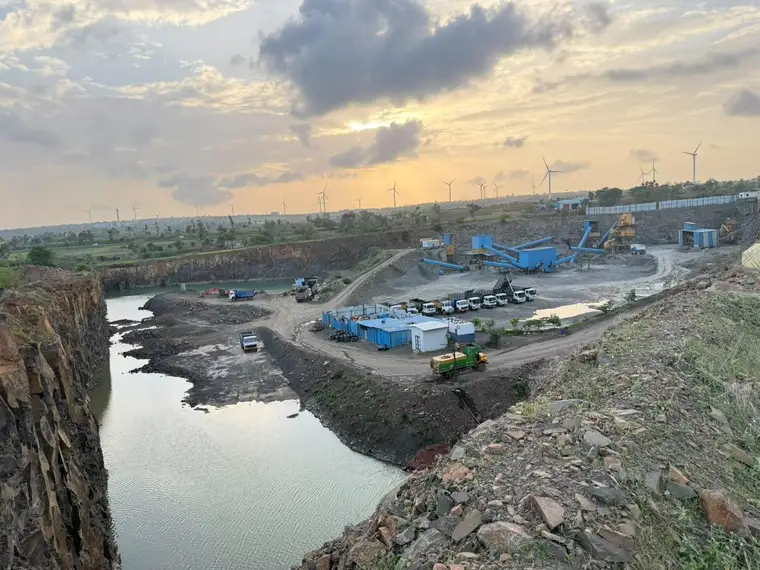
- We run fixed three-stage plants of 250 to 350 TPH and re-erect them in about two weeks, because the work we take is long packages.
Mobile crushers are sold on one photograph: a tracked machine walking off a trailer in the morning and crushing by the afternoon. The photograph is honest. It is also a picture of the first day, and a highway package has several hundred more.
For one quarry feeding a package that runs eighteen months to three years, a fixed three-stage plant usually suits better. It has more stages and screens, holds a grading more tightly, and costs less per tonne to run over a long job. For a short job, a small quantity or rock spread across several sources, a mobile unit is the right machine and a fixed plant is the wrong one.
Three kinds of plant, not two
The usual comparison is mobile against stationary, but there are three machines in it. A stationary plant stands on cast foundations, or on steel skids over a prepared base, with the crushers, screens and conveyors laid out across a yard. A wheeled plant carries a crusher or a screen on a trailer chassis and is towed between sites, then jacked and packed level. A track-mounted plant sits on crawler tracks with its own engine and moves itself around a site.
Set-up time and foundations
This is the mobile plant's strongest ground. A fixed plant needs foundations cast and cured, a feed ramp built to the hopper, structure raised and electricals run. On our plants that is about two weeks from the machines landing to material coming off the last belt, and about a month from order to steady production once the move is counted. The first 30 days of a plant set-up goes through it.
A track-mounted unit needs firm, level ground and little else, and a wheeled unit sits between the two. What matters is the share of the job the set-up takes. Two weeks of erection is a small slice of a three-year package and a large slice of a three-month one.
Stages, screens and control of the grading
A highway does not want one product. It wants GSB, WMM, 40mm, 20mm, 10mm and dust, several of them in the same week, each to a grading that the site engineer will test. Producing that takes a primary jaw, a secondary cone, a tertiary stage and several screen decks, with oversize from the screens sent back to a crusher in a closed circuit. What each stage of a three-stage plant does covers the reasoning.
On a fixed plant all of that is laid out with room around it: space for another screen, a surge pile between stages, a return belt. Change the specified grading mid-project and the decks are changed in a shift. A mobile unit is normally one stage on one chassis, so three stages means a train of machines feeding each other. It is done, and done well, but everything has to fit the chassis, and adding a deck or a return circuit is harder than on open ground.
Running cost over a long job
No figures here, because they differ by site, but the direction is consistent. A fixed plant runs on electric drives from the grid or from gensets, with one power system for the whole plant, and its crushers have walkways and lifting room for a liner change. A track-mounted train carries an engine, hydraulics and an undercarriage on every unit, each of them something more to fuel and service for every tonne produced.
On a short job this hardly matters: mobilisation is most of the cost and a mobile plant mobilises cheaply. On a long job the position reverses. Mobilisation is paid once and the running cost is paid on every tonne for two or three years.
Moving between faces and sources
A fixed plant stays put and the rock comes to it by tipper. As the face advances the haul to the hopper grows, which is why a well-built haul road matters on a long job. A track-mounted primary can follow the face and crush inside the pit, so that what travels is crushed rock and not boulders.
Where the stone lies in several small deposits along an alignment, none big enough to feed a package alone, a plant that moves easily has an advantage no fixed plant can match. Where there is one good quarry with years of reserve, that advantage is never used.
The three side by side
| Point | Fixed three-stage plant | Wheeled mobile plant | Track-mounted mobile plant |
|---|---|---|---|
| Foundations | Cast concrete or skids on a prepared base | Level hardstanding, jacked and packed | Firm level ground |
| Set-up | Longest: about two weeks to erect ours | Shorter | Shortest |
| Stages | Three on one layout | One per chassis, combined as a train | One per unit, combined as a train |
| Products at once | Widest range | Moderate | Narrower unless several units run together |
| Grading control | Easiest: more decks and closed circuits | Good, limited by the chassis | Good, limited by the chassis |
| Moving within a site | Does not move | Towed and reset | Moves itself |
| Running cost on a long job | Usually lowest per tonne | In between | Usually highest per tonne |
| Suits | One quarry, long package, high volume | Medium jobs, a few moves | Short jobs, scattered sources, in-pit and recycling |
Capacities and costs for mobile plants vary by maker and model and are not quoted here.
Why we run fixed plants, and where we would not
All six of our plants are fixed three-stage plants of 250 to 350 TPH. The work we take is highway packages that last eighteen months to three years and draw on one quarry, where a single 250 TPH plant is rated for up to 1,00,000 MT a month on two shifts. The Ujjain to Jaora greenfield highway, 98.73 km fed from a 250 TPH three-stage plant, is the kind of job our plant operations are built around.
Fixed does not mean permanent. Our plants are dismantled, carried on low-bed trailers and re-erected in about two weeks. The equipment list shows what travels with them.
A mobile unit is the better choice, and we will say so, when:
- the job is a few months long and the plant would spend a large part of it being erected and stripped;
- the total quantity is small enough that foundations cannot be justified;
- the rock comes from several scattered sources and the plant has to keep moving;
- the work is recycling demolition concrete or old pavement, or primary crushing inside a pit.
Standards and sources
- Plant configuration, re-erection time, monthly output and project details: SM Infra's own operating record
- Mobile plant characteristics are described from general trade practice; no capacities or costs are quoted, and makers' data sheets govern for any particular model
Your contract and its technical schedules override anything written here. Check the clause before you build to it.