
In short
- Overburden is everything above sound rock: topsoil, soil, morrum and weathered rock. It earns nothing.
- Stripping ratio is waste moved per unit of rock won. In bank cubic metres of overburden per bank cubic metre of rock, 3 m of cover over 15 m of rock is 0.2.
- Blasted hard rock swells by about 50 to 70 percent as a planning range. Tippers fill by loose volume, while stripping is measured in the ground.
- Before agreeing a rate, settle who strips, whether it is inside the per-tonne rate, and how it is measured.
A lease can hold excellent stone and still make a poor quarry. What lies on top decides it.
Overburden is the soil, morrum and weathered rock sitting above sound rock. Stripping ratio is how much of it you must move to win one unit of rock. Thin soil over a deep body of hard rock gives a low ratio and a lease that opens quickly. A thick weathered cap over a shallow band of good stone may not be worth a crusher at all.
What counts as overburden in a stone quarry
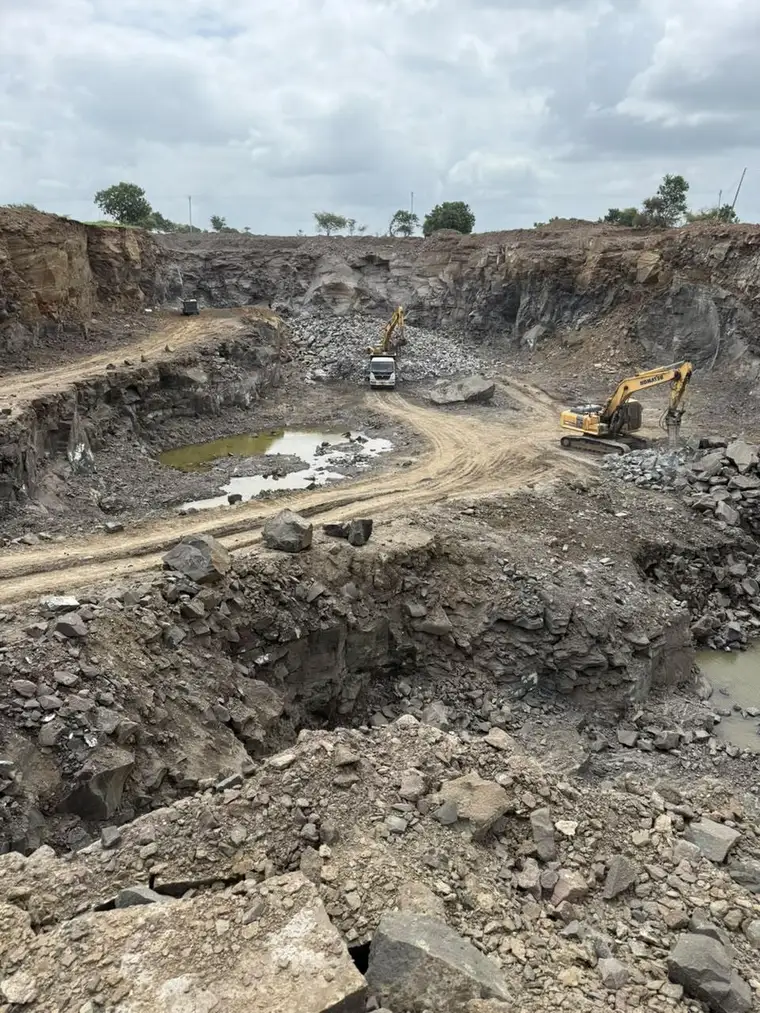
From the top down: topsoil, then subsoil and clay, then morrum or other gravelly material, then weathered rock, which is the parent rock rotted until it is soft, stained and open-jointed. The boundary with sound rock is seldom a clean line, because weathering follows joints downwards. The weathered layer is the awkward one: too hard to dig freely, too poor to sell as aggregate.
Stripping ratio defined
Stripping ratio = volume of overburden removed, divided by volume of rock won. Here both are bank cubic metres, measured in the ground before anything is disturbed. You will also meet it as cubic metres of waste per tonne of rock, or tonne for tonne, so state the units every time.
Why the ratio decides the source, and why it moves
Stripping is paid for in excavator hours, tipper trips and sometimes explosives. At a high ratio every saleable tonne carries a slice of waste haulage, and the source loses to a quarry further away with clean rock near the surface. Weigh it alongside lead distance to the road when choosing between two leases.
The ratio is not one number for a lease. Cover is thin on ridges and thick in hollows, and the rock may dip so that cover deepens as the face advances. Trial pits or probe holes drilled across the lease, logged for depth to sound rock, cost little against finding out with a plant erected.
Soft overburden and rocky overburden
| Material | How it is removed | Where it can go |
|---|---|---|
| Topsoil | Excavator or loader, stacked on its own | Kept for restoration |
| Soil, clay and morrum | Excavator and tipper | Bunds, haul road formation, the dump |
| Weathered rock | Excavator where it digs; drill and blast where it does not | Haul road base and fill, if it is not clayey |
| Hard, rocky overburden | Drill and blast, then loaded like production rock | Fill, bunds, the dump |
Check the mining plan and the lease terms before any stripped material leaves the lease.
Soft overburden is an earthmoving job. Rocky overburden is a blasting job: we fracture it with a drilled pattern in the same way as production rock, because a hydraulic breaker would take a month over it at ten times the cost. The two cost very different amounts per cubic metre, so a rate that says only 'overburden' is a dispute waiting for its first hard band.
The stripped edge is regulated. Regulation 106 of the Metalliferous Mines Regulations, 1961, which DGMS has applied to stone quarries for decades and which are being replaced by regulations under the OSH Code, 2020, requires sides in alluvial soil, morrum, gravel, clay or debris to be sloped at no more than 45 degrees unless the Regional Inspector permits another angle, or benched no higher than 1.5 m with each bench at least as broad as it is high. It also keeps trees, loose stone and debris 3 m back from the edge. Check the regulation currently in force before relying on either figure.
Bank, loose and compacted volumes
Bank volume is what it occupies in the ground. Loose volume is what it occupies in a tipper or a dump, which is more because the pieces no longer fit together. Compacted volume is what it occupies once placed and rolled. Swell is the increase from bank to loose, as a percentage.
For well-blasted hard rock, published earthwork tables put swell at about 50 to 70 percent, with 60 to 65 percent typical. That is a starting point; the rock and the blast decide the real figure. One such table lists basalt at 2.94 tonnes per cubic metre in the ground and 1.79 loose, a swell of 64 percent. So 1,000 bank cubic metres of that basalt weighs 2,940 tonnes and fills about 1,640 cubic metres of tipper body or dump.
Stripping is normally measured as bank volume by survey, and tippers are counted in loads. Convert between the two without an agreed swell figure and the quantities will not reconcile. Converting between tonnes and cubic metres has the same trap for finished aggregate.
Where the overburden goes
A dump is permanent once built, so site it once. Keep it off rock you will want to quarry later. Keep it out of drainage lines, because a dump across a nala is a dam in its first monsoon, and far enough from the face and the haul road that it cannot slump onto either. The approved mining plan normally fixes where a dump may stand, so read it before the first load is tipped.
Much of it need not be dumped at all. Morrum and weathered rock go into the bunds that screen a quarry and into haul road formation, and building a quarry haul road starts with exactly this material. Topsoil is the exception: stack it apart, keep tippers off it and hold it for restoration.
Stripping ahead of the face, but not too far
Stripping has to stay ahead of drilling. If the drill catches up with the overburden the face stops, and soon afterwards the hopper is empty. The opposite fault is quieter. Strip a whole season's ground at once and the work is paid for months before the rock under it earns, while bare ground lies open to a monsoon.
Keep enough rock uncovered for the blasts planned over the coming weeks, and finish the stripping the wet months will need before the rain arrives, because soil stripped in rain is slurry. Monsoon planning for a quarry site covers the rest.
What to ask before agreeing a rate
- Who strips: the lease holder or the mining contractor?
- Is stripping inside the per-tonne rate for rock, or paid separately per cubic metre?
- If separate, is soft overburden priced apart from rock that needs blasting?
- How is it measured: bank volume by survey, or tipper loads at an agreed factor?
- What happens to the rate if the cover turns out deeper than the survey showed?
On the leases we mine, most of them client-held, we look at overburden depth on the first visit. It is better argued over a trial pit than an invoice.
Standards and sources
- Metalliferous Mines Regulations, 1961, regulation 106(1) and 106(4) (opencast workings), read with the Occupational Safety, Health and Working Conditions Code, 2020; check the regulations currently in force
- Dyno Nobel, Blasting and Explosives Quick Reference Guide (2010): solid density of rock types
- Published highway-agency earthwork tables: in-situ density, loose density and swell of blasted rock
- Overburden stripping and blasting practice: SM Infra's own operating record
Your contract and its technical schedules override anything written here. Check the clause before you build to it.