
In short
- The haul road sets cycle time, tyre life and fuel burn, and a properly built one pays for itself inside a month.
- The figures come from DGMS safety alerts, not the 1961 regulations: gradient not more than 1 in 16 (6.25%) as best practice in Safety Alert 20/2025, and width at least three times the largest vehicle in an alert of 27 November 2025.
- By one manufacturer's table, rolling resistance runs from 3% on a firm, watered road to 20% in soft mud. Each point loads the tipper like one more per cent of gradient.
- Build in layers with cross-fall and side drains, then keep a grader and a water tanker on it. The maintenance is the road.
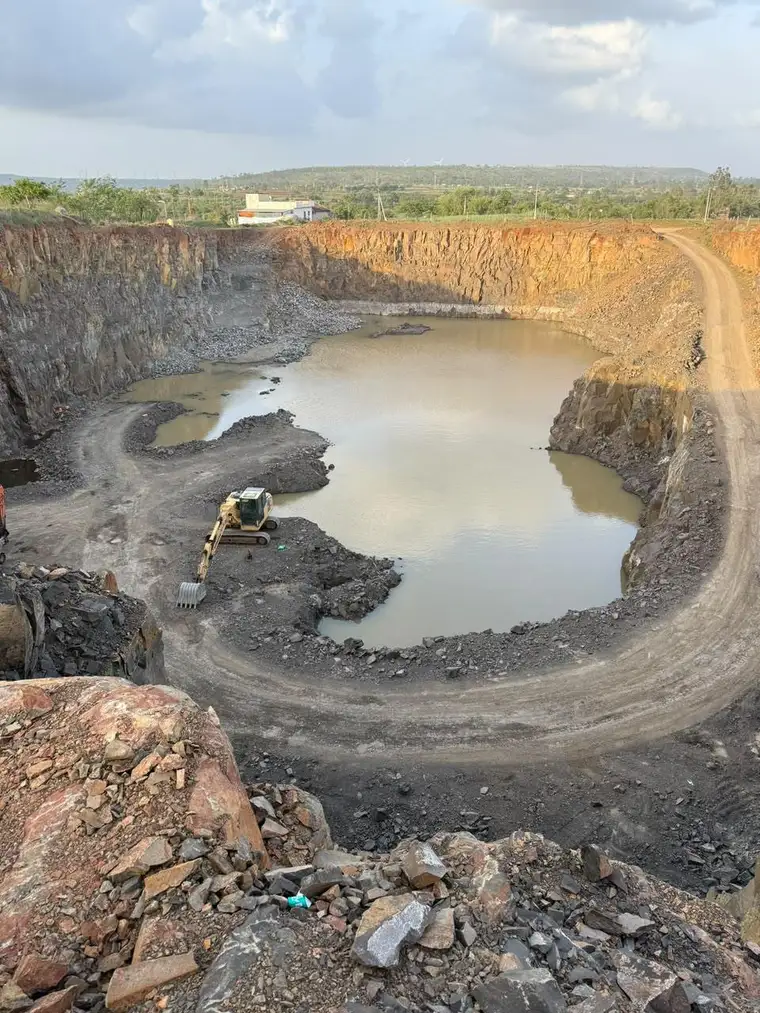
On most quarries the haul road is whatever the tippers have worn into the ground between the face and the hopper. Nobody designed it, nobody maintains it, and everybody pays for it: in tyres cut on loose stone, springs and chassis cracked in potholes, diesel burned in low gear, and loads per shift that never reach the plan.
A haul road worth the name has a gradient a loaded tipper can climb without crawling, width for two vehicles to pass, a surface that sheds water and a drain beside it. The figures below are the ones DGMS has put in writing. The rest is construction and upkeep, and it costs less than the tyres.
Why the road is production equipment
A plant is fed by cycles: load, haul, tip, return. Short leads and a clean haul road are worth more than an extra machine, because an extra tipper on a bad road is one more vehicle in the same slow queue.
The measure of a road surface is rolling resistance: the force needed to keep a wheel turning, as a percentage of the vehicle's weight. One manufacturer's published table puts a hard, smooth surface at 1.5%, a firm, maintained and watered road at 3%, rutted soft dirt with about 100 mm of tyre penetration at 8%, and very soft mud at 20%. Each point loads the engine as one more per cent of gradient would. A flat road at 8% is, to the tipper, a 5% hill compared with the same road at 3%.
That is why a properly built haul road pays for itself in tipper tyres and cycle times inside a month. The cycle-time arithmetic for tipper numbers shows what a minute off each trip is worth.
What DGMS says on gradient and width
The Metalliferous Mines Regulations, 1961, which DGMS has applied to stone quarries for decades and which are being replaced by regulations under the OSH Code, 2020, contain no haul road gradient or width figure. The numbers quarry managers quote come from DGMS safety alerts and circulars, from the conditions attached to individual permissions, and from the coal mine regulations. Check the regulation currently in force, and your own permission letter, before building to any of them.
| Element | Guidance | Why |
|---|---|---|
| Gradient | Not more than 1 in 16, which is 6.25% (DGMS Safety Alert 20/2025, as best practice) | A loaded tipper holds speed going up and stays inside its brakes coming down |
| Width | At least 3 times the width of the largest vehicle (DGMS safety alert, 27 November 2025) | Two vehicles pass with clearance between them and on both sides |
| Edge protection | A strong parapet wall or berm of adequate dimensions where the road stands above the ground beside it. DGMS gives no height figure | Stops a vehicle that has lost steering or brakes from going over the edge |
| Surface | Firm, smooth, graded and watered. About 3% rolling resistance, against 8 to 14% on rutted soft ground | Tyres, fuel, cycle time and chassis life |
| Cross-fall and drains | Enough fall to shed water to a side drain. Set the figure on site; we have no verified one to print | Water standing on the road becomes water in the road |
Manufacturer guidance for large mine trucks quotes ideal grades of 8 to 10%. The DGMS figure is stricter, and it is the one an Indian quarry is inspected against.
At 1 in 16, a ramp that climbs 10 m needs at least 160 m of length, so it has to be planned into the pit layout with the bench geometry before the benches leave no room for it. And width means running width, clear of drain and berm, against the widest machine that uses the road, which may be a wheel loader or a low-bed, not a tipper.
Building it in layers
- Shape the sub-grade. Cut out soft spots and topsoil, grade the formation to line and cross-fall, and compact it with a roller at workable moisture. A road built on uncompacted tip ruts along the wheel tracks in the first wet spell.
- Lay a base of quarry scalpings, broken overburden rock or GSB-type graded material, spread in layers and rolled. This layer carries the axle load, so it is thickest on weak ground and on ramps.
- Add a wearing surface: a well-graded crushed material with enough fines to bind and not so many that it turns to slurry. Single-size stone rolls about under the tyres and cuts them.
- Give it cross-fall and a drain. Fall the surface to one side or from a crown, and cut a side drain that leads somewhere lower than the road.
- Build the berm on every open edge from the start, not after the first near miss.
None of this needs bought-in material on a crusher site: scalpings and GSB come off the same plant the road serves, and haul roads are a listed use of the GSB we produce. Thickness depends on the ground and the axle loads, so we do not quote one.
Not every track earns layers. A spur to a corner of the face that will be worked out in a few weeks needs grading, a drain and a berm, and nothing more. The main haul from pit to hopper, which every tonne crosses for the life of the site, is the one to build properly.
Keeping it with grader, water and patching
A haul road is never finished. Tyres pull the fines out, spillage leaves stone on the running surface, and every rain opens the weak spots.
- Grade it on a schedule. A motor grader recuts the cross-fall, fills the wheel tracks and pushes spilled stone off the running surface.
- Water it. A tractor and water tanker on the road through the dry months keeps the fines in place and the dust out of air filters. Too much makes a slick, so little and often.
- Patch after rain, not after the pothole has broken a spring. Fill with graded material and compact it. A pothole filled with loose boulders is two potholes.
We own two motor graders, three road rollers and nine tractors for site logistics and water tankers, and haul roads are part of the earthwork we do on the quarries we run. What is unusual is not the machines. It is keeping them on the road when the plant is shouting for feed.
Before the monsoon
Rain finds every shortcut. In the weeks before it breaks, recut the cross-fall, clean and deepen the side drains, open their outlets, and put a stock of graded patching material where a loader can reach it when the pit floor cannot be crossed. Ramps come first, because a ramp that washes out cuts the face off from the hopper. Monsoon planning for a quarry and crusher site covers the pit sump, the stockpiles and the plant.
Standards and sources
- DGMS Safety Alert 20/2025 (25 September 2025): haul road gradient
- DGMS safety alert of 27 November 2025: haul road width; DGMS safety alerts on parapet walls and berms
- Metalliferous Mines Regulations, 1961, and the Occupational Safety, Health and Working Conditions Code, 2020 (in force from 21 November 2025)
- Rolling resistance factors and grade guidance: Caterpillar published tables, used as rules of thumb
- US 30 CFR 56.9300(b), berm height: a rule of thumb only, not Indian law
- Grader, roller, tractor and service figures: SM Infra's own operating record
Your contract and its technical schedules override anything written here. Check the clause before you build to it.