
In short
- For hard and compact ground, Regulation 106 of the Metalliferous Mines Regulations, 1961 prints no bench height. It says the sides must be adequately benched, sloped or secured.
- The 6 m height and 60 degree slope apply to float deposits worked by manual means on a sloping face, with 7.5 m possible on the Regional Inspector's permission.
- A quarry using deep-hole blasting or heavy machinery gives 60 days' written notice and works under conditions the Chief Inspector specifies. Those conditions carry its bench figures.
- The 1961 regulations are being replaced under the OSH Code, 2020. Read the regulation in force and your own permission before building to any number.
Ask five quarry people for the legal bench height and four will say six metres. It is the most repeated number in Indian quarrying, and it is nearly always quoted without the words around it.
The short answer: Regulation 106 of the Metalliferous Mines Regulations, 1961 gives no bench height for hard and compact ground, only that the sides be adequately benched, sloped or secured. The 6 m and 60 degree figures belong to float deposits worked manually, and a mechanised quarry takes its bench dimensions from the conditions attached to its own permission.
Bench, face, crest, toe and berm
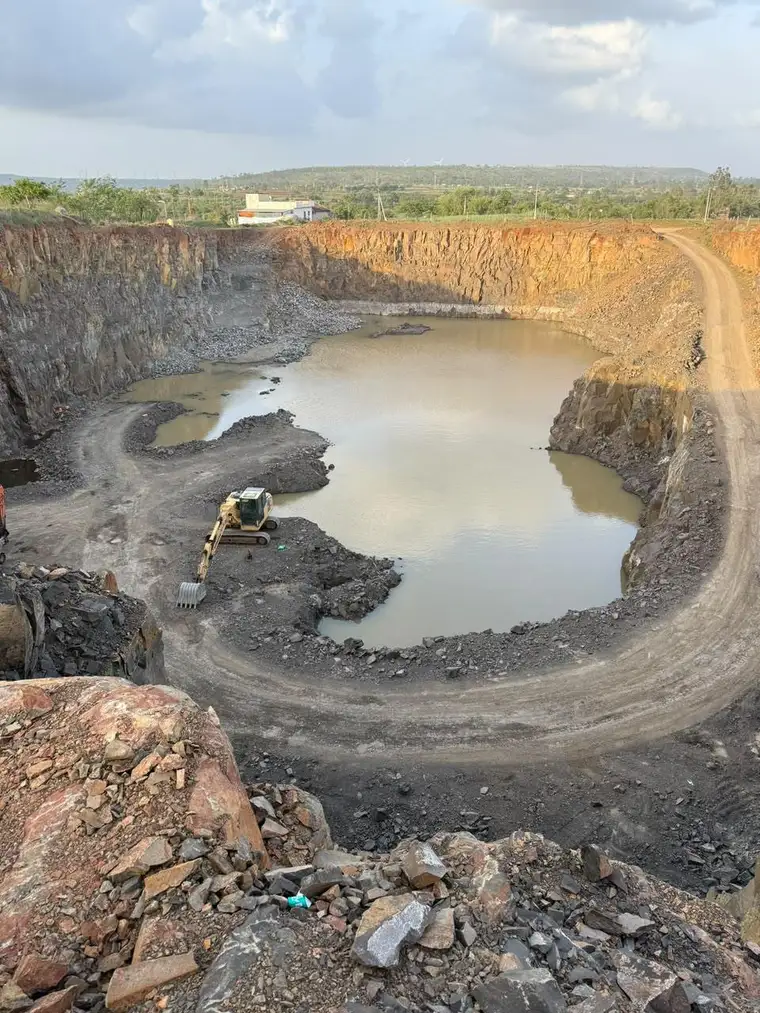
A bench is a step cut into the rock: a level floor for machines, with a steep wall above it and another below. The wall is the face. The crest is the top edge of a face and the toe is its bottom edge, where it meets the floor. Bench height is measured vertically from toe to crest, bench width is the floor from the crest back to the next toe, and face angle is the slope of the face from the horizontal.
Berm has two meanings on site: the strip of bench left when a face reaches its final position, which catches what falls from above, and the bank heaped along an open edge to stop a wheel going over.
Why a quarry is worked in benches
One high face looks like less work than a staircase. Three things rule it out.
- Stability. A high face holds more loose rock above the people under it. On a benched face a fall lands on the bench below.
- Loading height. The excavator has to reach the rock it is digging under. A block hanging above the boom cannot be scaled down, and comes down when it chooses.
- Drilling access. Every blast hole is drilled from the bench above, and the depth to which the rig holds a straight hole sets how much rock can be shot in one lift.
What Regulation 106 says
Bench geometry has long been governed by Regulation 106 of the Metalliferous Mines Regulations, 1961, which DGMS has applied to stone quarries for decades and which are being replaced by regulations under the OSH Code, 2020. The Code came into force on 21 November 2025 and replaced the Mines Act, 1952, and new metalliferous mines regulations under it were in draft in 2026. Check the regulation currently in force before relying on any figure here.
| Ground or method | What the regulation requires |
|---|---|
| Alluvial soil, morum, gravel, clay, debris or similar ground: 106(1)(a) | Sides sloped at not more than 45 degrees from the horizontal, or another angle the Regional Inspector permits. Or benched, with height not more than 1.5 m and breadth not less than the height |
| Float or similar deposit, worked by manual means on a sloping face: 106(2)(a) | Face benched, sides sloped at not more than 60 degrees. Bench height not more than 6 m, breadth not less than the height |
| The same working in comparatively hard and compact rock: proviso | The Regional Inspector may permit height up to 7.5 m, with width not less than 6 m |
| Deep-hole blasting, heavy machinery, or both: 106(2)(b) | Written notice to the Chief Inspector and Regional Inspector at least 60 days before starting. Work only under the conditions the Chief Inspector specifies |
| Hard and compact ground: 106(3) | Sides adequately benched, sloped or secured. No height, width or angle is given |
| The edge of the working: 106(4) | No tree, loose stone or debris within 3 m of the edge |
| Any face: 106(5) | No undercutting and no overhangs |
Summarised from the 1961 text. The Chief Inspector may relax the 106(2)(a) limits in special difficulties.
Where the 6 m rule applies
Float is loose, detached mineral lying at or near the surface, not solid rock in place. Sub-regulation (2)(a) is written for that kind of deposit, dug by hand on a sloping face. For that working only, the regulation gives 6 m of height, 60 degrees of slope and a bench at least as broad as it is high.
A granite or basalt quarry feeding a crusher is not a float deposit, and nobody digs it by hand. Sub-regulation (3) is the line that speaks to hard and compact ground, and it carries no number. Adequate is judged on that rock, by the inspectorate.
The notice route for mechanised quarries
Sub-regulation (2)(b) covers nearly every quarry that feeds a crusher plant. Where the working uses deep-hole blasting, heavy machinery or both, the owner, agent or manager gives written notice at least 60 days before starting, then works only under the conditions the Chief Inspector specifies. The trade calls this DGMS permission. Strictly it is a notice, followed by conditions.
Those conditions are where a mechanised quarry's bench height, width and slope are fixed. They commonly relate bench height to the reach of the machine working the face, but that is a condition of the permission and not a line in Regulation 106, so read your own letter. Sixty days is also programme time, so the notice goes in well before the first bench is cut.
What the machine and the drill decide
Inside whatever the conditions allow, the equipment settles the geometry. The excavator sets a ceiling on height, because a face it cannot reach to scale is a face nobody should load under. The drill sets another: hole diameter and bench height go together in a blast pattern, and a rig that drifts off line at depth should not be asked for a deep bench.
Width comes from what has to fit on the floor at once: the drill, the blasted rock thrown forward, an excavator swinging, a tipper turning, and an edge strip kept clear. A working bench is therefore far wider than the berm left at the final face. Ramps eat width too, and a haul road has its own rules on width and gradient.
What to look for on a site visit
- Bench floors cleaned back to the toe.
- Crests that are not undercut. An excavator digging in under a face for easy rock leaves the overhang that 106(5) forbids.
- Edges clear of loose stone, spoil and trees, which is the 3 m rule in 106(4).
- Berms still there: the catch berm on a finished face not mined away, and a bank along edges where tippers run.
- A copy of the notice and the conditions on site. Ask to see it.
On the quarries we open and run, overburden is stripped and benches are cut to a working geometry before production starts, so that drilling and loading are repeatable and not improvised. At hand-back the benches are left safe and the faces stable.
Standards and sources
- Metalliferous Mines Regulations, 1961, Regulation 106 (Opencast workings), sub-regulations (1) to (5)
- Occupational Safety, Health and Working Conditions Code, 2020, in force from 21 November 2025, replacing the Mines Act, 1952; draft metalliferous mines regulations under the Code, 2026
- Bench preparation and hand-back practice: SM Infra's own operating record
Your contract and its technical schedules override anything written here. Check the clause before you build to it.