
In short
- Stone for aggregate is a minor mineral. The state grants leases and permits under rules made under section 15 of the MMDR Act, 1957, so the detail differs in every state.
- The usual stack is a lease or permit, an approved mining plan, a valid District Survey Report, prior environmental clearance, pollution board consent and mine-safety compliance.
- Since the Supreme Court's Deepak Kumar judgment of 27 February 2012, leases under 5 hectares also need prior environmental clearance. They are now appraised at state level.
- On 8 May 2025 the Supreme Court held that a valid, subsisting District Survey Report is mandatory and that a draft cannot support a clearance.
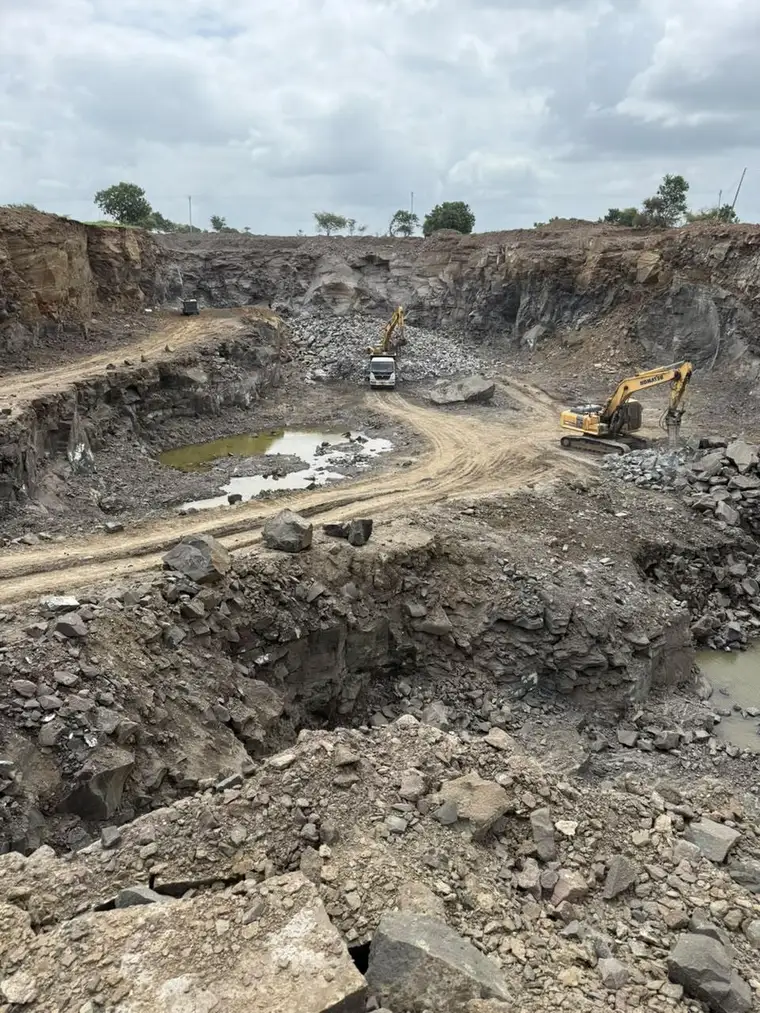
From the road, a lawful quarry and an unlawful one look the same: a face, a drill, an excavator and a queue of tippers. The difference is a file. When that file has a gap, the consequences land on whoever is buying the stone or has a crusher standing on the lease.
In outline, stone is a minor mineral regulated by the state, and a lawful quarry holds a lease or permit, an approved mining plan, prior environmental clearance resting on a valid District Survey Report, pollution board consent and mine-safety compliance. This is orientation for a contractor, not legal advice. The courts have reshaped the regime several times since 2012, so confirm the current position with the state mining department and the state environment authority.
Stone is a minor mineral and the state makes the rules
The Mines and Minerals (Development and Regulation) Act, 1957 defines minor minerals in section 3(e), and section 15 gives state governments the power to make rules for them. Stone quarried for aggregate falls in that class, so there is no national quarry licence. Uttar Pradesh works under its Minor Minerals (Concession) Rules, 2021, and every other state under rules of its own.
The grant may be called a mining lease, a quarry lease or a quarry permit. What matters to a buyer is the same each time: a named holder, a defined area, a period and a mineral.
The usual stack
| Document | Issued by | Why you ask for it |
|---|---|---|
| Lease deed or quarry permit | State mining department | Who may quarry, where and until when |
| Approved mining plan | Approved by the state mining department | Method of working and permitted production |
| District Survey Report | Prepared for the district | The clearance rests on it; must be final, not a draft |
| Environmental clearance | State Environment Impact Assessment Authority (SEIAA) | Mandatory before mining; carries conditions |
| Pollution board consent | State Pollution Control Board | A crusher on the lease needs it regardless |
| Mine-safety compliance | Overseen by DGMS | A quarry is a mine in safety law |
| Royalty account and transit passes | State mining department's system | Shows dispatches are accounted for |
Names, sequence and issuing office vary by state.
Lease and mining plan
A state may issue a letter of intent to the selected applicant and execute the lease deed only once the mining plan is approved. Under rule 35 of Uttar Pradesh's 2021 Rules, the mining plan is prepared by a recognised person, submitted within one month of the letter of intent and approved within 30 days. A letter of intent is therefore not a right to quarry.
The mining plan is the document a contractor should read. It sets the method of working and the production planned year by year. If the package needs more tonnes a year than the plan allows, the plan wins.
Environmental clearance since 2012
This layer has moved the most, and the dates matter because some quarries still hold clearances issued under an arrangement the tribunal later faulted.
- 27 February 2012. In Deepak Kumar v. State of Haryana the Supreme Court held that prior environmental clearance is needed for minor-mineral leases, including those under 5 hectares. A May 2012 office memorandum sent such leases to the SEIAA.
- 15 January 2016. Notification S.O. 141(E) created district-level authorities (DEIAA) to clear leases of up to 5 hectares, and introduced the District Survey Report and the treatment of neighbouring leases as a cluster.
- September and December 2018. The National Green Tribunal held that the 2016 arrangement diluted Deepak Kumar and directed that it not be acted upon.
- 28 April 2023. A further office memorandum required district-issued clearances to be re-appraised at state level.
- 8 May 2025. In State of Uttar Pradesh v. Gaurav Kumar the Supreme Court held that a valid, subsisting District Survey Report is mandatory and that a draft cannot support a clearance.
Today the district authorities are defunct in practice, and minor-mineral proposals, including those of 5 hectares and below, are appraised by the State Expert Appraisal Committee and the SEIAA. Old district-issued clearances were still being re-appraised in 2026, and not all have survived.
Clusters deserve a warning. Leases close to one another are counted together, and a cluster can push a small lease onto the heavier route, with an impact assessment and public consultation. The thresholds were at the centre of that litigation, so we have not printed them. Ask the SEIAA how the lease was classified.
Pollution board consent and mine safety
The State Pollution Control Board's consents are best known for crushers, which need them wherever they stand. Ask the board what it requires of the quarry itself. Consents and clearances for a stone crusher plant covers the crusher's side.
Mine safety is central, not state. A stone quarry is a mine, and its owner answers to DGMS for how it is worked. The detailed rules have long been the Metalliferous Mines Regulations, 1961, which DGMS has applied to stone quarries for decades and which are being replaced by regulations under the OSH Code, 2020. The Code came into force on 21 November 2025 and replaced the Mines Act, 1952. Check the regulation currently in force before relying on a number from the old one.
Blasting adds explosives licensing and a licensed shotfirer, set out in who is allowed to blast in an Indian quarry.
Two commercial arrangements
The client holds the lease and we produce against it. This is most of our work. You hold the mineral, and with it the lease, the mining plan, the clearance and the royalty account. We bring the machines, the plant, the crew and the compliance that lives on the ground: licensed shotfirers, explosive records and vibration monitoring. Write the division down.
We work our own lease and sell material. Where a client would rather buy stone than run a quarry, the stack is ours, and you receive material with a weighbridge slip and a transit pass.
Either way, on mining and quarry operations we plan three to six weeks from award to first tonne on a normal site. That assumes the stack is complete. Missing paperwork is the most common reason a quarry sits idle with a plant already erected.
What to ask to see
- The lease deed or permit, not the letter of intent. Check the holder's name, the area and the expiry date.
- The approved mining plan, and the production it allows against what you need.
- The environmental clearance letter: who issued it, when, and whether a district-issued one has been re-appraised.
- Confirmation that a final District Survey Report covers the lease.
- The pollution board consents, in date.
- A recent transit pass raised against the lease.
Then walk the boundary with the lease map. Working outside the demarcated area is the easiest violation to commit and the easiest for an inspector to prove.
Standards and sources
- Mines and Minerals (Development and Regulation) Act, 1957, sections 3(e) and 15
- Deepak Kumar v. State of Haryana, (2012) 4 SCC 629, Supreme Court of India, 27 February 2012
- Ministry of Environment, Forest and Climate Change: Office Memorandum of 18 May 2012; Notification S.O. 141(E) of 15 January 2016; Office Memorandum of 28 April 2023
- National Green Tribunal: Satendra Pandey v. MoEFCC (13 September 2018) and Vikrant Tongad (11 December 2018)
- State of Uttar Pradesh v. Gaurav Kumar, 2025 INSC 650, Supreme Court of India, 8 May 2025
- Uttar Pradesh Minor Minerals (Concession) Rules, 2021, rule 35 (mining plan)
- Occupational Safety, Health and Working Conditions Code, 2020 (in force 21 November 2025), and the Metalliferous Mines Regulations, 1961
- Lease arrangements and mobilisation period: SM Infra's own operating record
Your contract and its technical schedules override anything written here. Check the clause before you build to it.