
In short
- PESO licenses the possession, storage, transport and use of explosives under the Explosives Rules, 2008. DGMS regulates safety in the mine and the competence of the person firing.
- A magazine for use is licensed in Form LE-3. A small quarry holding up to 25 kg can be licensed by the District Magistrate; larger magazines go to the Chief Controller of Explosives.
- In a mine, the 1961 regulations require the blaster to hold a Manager's, Foreman's, Mate's or Blaster's Certificate and be appointed in writing. Outside mines, the shot firer needs a certificate in Form LE-10 from the Controller of Explosives.
- Before a blasting contractor starts, ask for the licence and its validity, the named shotfirer's certificate, the magazine location and the explosive stock records.
In an Indian quarry, explosives may be held only under a licence granted under the Explosives Rules, 2008, and a shot may be fired only by a person who holds a statutory certificate of competence. Two different authorities stand behind the two.
This is orientation for project managers and safety officers checking a blasting contractor's papers, not legal advice. The rules have been amended since they were notified, so confirm any form number that matters with PESO.
Two bodies, two jobs
The Petroleum and Explosives Safety Organisation (PESO), through its Controllers and the Chief Controller of Explosives, administers the Explosives Rules, 2008. Those rules decide who may possess explosives, in what quantity, in which magazine and how they travel by road.
The Directorate General of Mines Safety (DGMS) looks at the other side: the safety of the working, the danger zone and the charge limits near buildings, vibration at nearby structures and the competence of the blaster. Rule 97 of the Explosives Rules draws the line itself: blasting in mines follows the mines legislation. A quarry answers to PESO for the explosive and to DGMS for the shot.
The licence forms
| Licence | What it allows | Who grants it |
|---|---|---|
| LE-3, article 3(a) | Possession for use in a small quarry or for agriculture: up to 25 kg of Class 1, 2 or 3 explosives, 1,500 detonators and 1,500 m of detonating or safety fuse, in a magazine | District Magistrate |
| LE-3, article 3(c) | Possession for use of explosives of Classes 1 to 7 in a magazine | Chief Controller of Explosives, or a Controller he authorises |
| LE-7 | Transport of explosives in a road van | Controller of Explosives |
| LE-1, article 1(f) | Manufacture of site mixed explosives (SME), using bulk mix delivery vehicles and a support plant | Chief Controller of Explosives, or a Controller he authorises |
| LE-10 | Shot firer's certificate | Controller of Explosives |
Forms as in the rules as notified by G.S.R. 907(E) on 29 December 2008. Later amendments were not checked for this article. LE-5 and LE-6, sometimes quoted for road vans and bulk explosive, are shop and fireworks licences.
For a stone quarry with its own magazine the working licence is LE-3: article 3(a) from the District Magistrate if the quantities are small, article 3(c) from PESO if they are not. A condition of LE-3 is that explosives are not to be used outside mines unless a qualified shot firer is employed.
The magazine
A magazine is the licensed store, and the licence belongs to it: one holder, one location, one maximum quantity. Where it may stand is decided by the safety distances in Schedule VIII of the rules. Ammonium nitrate has rules of its own, the Ammonium Nitrate Rules, 2012, also administered by PESO.
On our quarry sites the magazine goes in with the camp, fuel store and workshop, before production and not during it. Paperwork of this kind is the commonest reason a quarry sits idle with a plant already erected. The lease and clearance side of it is described in quarry lease, mining plan and environmental clearance.
Who may fire a shot
In a mine, the answer comes from the Metalliferous Mines Regulations, 1961, which DGMS has applied to stone quarries for decades and which are being replaced by regulations under the OSH Code, 2020. Regulation 2(6) defines a blaster as a person holding a Manager's, Foreman's, Mate's or Blaster's Certificate who has been appointed in writing by the manager, and the term includes a shotfirer.
Regulation 160 then puts the work on that person. Charges are prepared, and holes charged and stemmed, by the blaster or under his personal supervision, and the blaster fires the shots himself. One clause is worth knowing when you read a contractor's wage structure: nobody paid by the quantity of rock broken may be appointed blaster.
Outside mines, Rule 98 of the Explosives Rules, 2008 applies. Blasting is done only by a shot firer holding a valid certificate in Form LE-10, issued by the Controller of Explosives on an application in Form AE-10. It is valid for five years, is revalidated for five years at a time, and a copy is carried during blasting. It is issued by category, from A (unlimited) and B (general aboveground) through to demolition, seismic and agricultural work, so check that the category fits the job.
A stone quarry is a mine in law
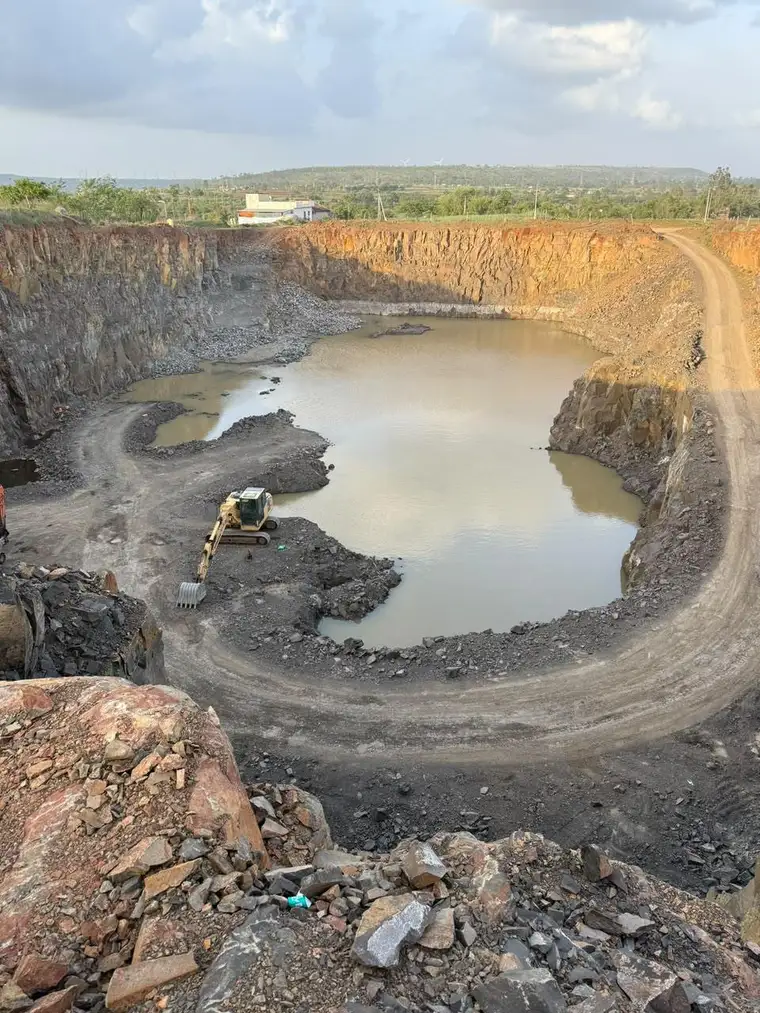
Under section 2(1)(j) of the Mines Act, 1952, a mine is any excavation where an operation to search for or obtain minerals is carried on, and that includes opencast workings. A stone quarry fits, and DGMS has cited quarry owners under the metalliferous mines regulations.
That Act has now been repealed. The Occupational Safety, Health and Working Conditions Code, 2020 came into force on 21 November 2025, and draft metalliferous mines regulations under it were published in February 2026. At the time of writing we had not found a final notification. Check which regulation is in force before a 1961 regulation number goes into a contract or a safety plan.
Records and returns
Receipts of explosive go in Form RE-3. Explosives used go in Form RE-5, which records the shot firer's name and permit number and the quantity used and returned. Under Rule 24 the stock books are page-numbered and certified, records are kept for three years, and a quarterly return goes to the Controller and the District Magistrate by the tenth day of the following quarter.
For a client, the useful check is whether the explosive shown as used agrees with the blast records for the same days. On our sites the magazine licence and explosive movement records are kept on site, and the paperwork exists before the explosive arrives.
What to ask a blasting contractor for
- A copy of the explosives licence: the form and article, the name of the licensee, the magazine address, the licensed quantity and the date to which it is valid.
- The certificate of the named person who will fire, its category and validity, and in a mine the manager's written appointment.
- Where the magazine is, how far it is from the face, and how explosive travels between the two.
- The explosive receipt and usage records for a recent quarter.
- Insurance that covers damage to third-party property.
- A sample blast design and the vibration records that go with it, which the DGMS vibration limits explain how to read.
The same applies in reverse. Whether we can blast on a principal contractor's licence depends on what it covers and who is named on it, so send it to our blasting team and we will say plainly whether it works, before anybody finds out at the magazine.
Standards and sources
- Explosives Rules, 2008 (G.S.R. 907(E), 29 December 2008): Schedule IV Part 1 (licence forms LE-1 to LE-10), Schedule V Part 5 (record forms RE-3 and RE-5), Schedule VIII (safety distances), Rules 24, 97 and 98
- Metalliferous Mines Regulations, 1961, Regulations 2(6) and 160
- Mines Act, 1952, section 2(1)(j); Occupational Safety, Health and Working Conditions Code, 2020, in force 21 November 2025
- Draft Occupational Safety, Health and Working Conditions (Metalliferous Mines) Regulations, 2026, G.S.R. 109(E), 4 February 2026
- Ammonium Nitrate Rules, 2012
- Licensing, magazine and site records practice: SM Infra's own operating record
Your contract and its technical schedules override anything written here. Check the clause before you build to it.