
In short
- The sand replacement test (IS 2720 Part 28) finds the in-place dry density of a compacted layer. Divided by the laboratory MDD and multiplied by 100, that is percent compaction.
- The hole's volume comes from the mass of calibrated sand that fills it. Bulk density is soil mass over that volume, and dry density is bulk density divided by (1 + w).
- On a failing result, check the test and the reference MDD before blaming the roller. A wrong MDD fails good work and passes bad work.
- MoRTH Clause 903.2.2 asks for sets of ten tests: one per 3,000 m2 of each embankment layer and one per 2,000 m2 of sub-grade.
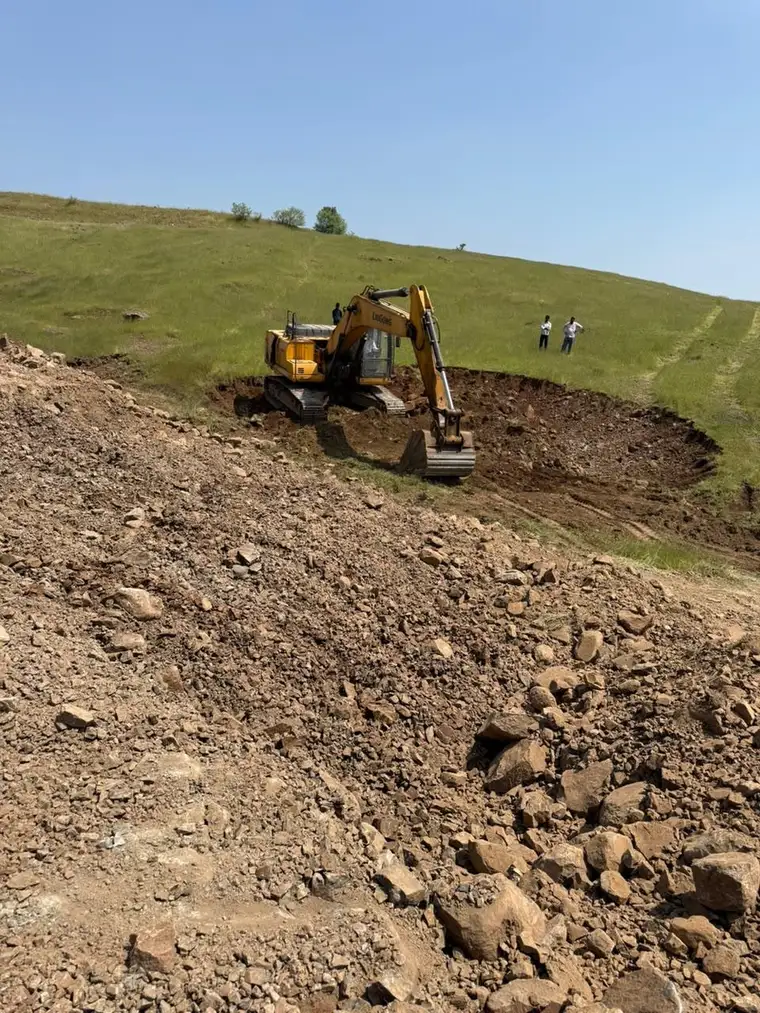
A compacted layer covering several thousand square metres is accepted or rejected on what comes out of a few small holes dug into it. The field density test, FDT on most sites, measures the dry density of the soil as it lies after rolling.
Set against the maximum dry density (MDD) the same soil reached in the laboratory, that gives percent compaction: field dry density divided by MDD, times 100. MoRTH wants not less than 95% in embankment and 97% in sub-grade, and the method it names is sand replacement, IS 2720 Part 28. This is the procedure, the arithmetic, and what to do when the answer comes back at 94.
What the test measures
Density is mass over volume. The mass is easy: dig the soil out and weigh it. The volume of an irregular hole is the hard part, and sand replacement solves it by filling the hole with a dry sand whose bulk density was measured beforehand. The mass of sand in the hole, divided by the sand's density, is the volume of the hole.
A moisture content on the excavated soil (IS 2720 Part 2) converts bulk density to dry density, because the specification is written in dry density. Water has weight but is not soil.
The methods MoRTH recognises
| Method | Standard | Where it fits |
|---|---|---|
| Sand replacement | IS 2720 (Part 28):1974 | The reference method for embankment and sub-grade density under Clause 903.2.2 |
| Core cutter | IS 2720 (Part 29):1975 | Fine-grained soils free of aggregations only. The standard itself rates it less accurate than sand replacement |
| Nuclear density gauge | Calibrated to match IS 2720 (Part 28) | Only where the Engineer permits it (Clauses 111.7 and 305.3.6). The number of tests is doubled |
Clauses are from the MoRTH Specifications, Fifth Revision (2013).
The procedure, step by step
- Calibrate the sand. With the same clean, dry, uniformly graded sand and pouring cylinder you will use on site, find the bulk density of the sand as poured and the mass that fills the cone.
- Level a small area of the compacted layer and seat the metal tray flat on it.
- Dig the hole through the tray opening to the depth the standard calls for. Put every bit of excavated soil into a container and close it.
- Weigh the excavated soil. This is the wet mass, W.
- Weigh the pouring cylinder full of sand, set it over the hole, open the shutter and let the sand run until it stops. Close the shutter and weigh the cylinder again.
- Find the mass of sand in the hole: the sand that ran out, less the sand that filled the cone. Divide by the sand's calibrated density to get the volume of the hole, V.
- Take a representative sample of the excavated soil for moisture content, w, by oven drying or a rapid method the Engineer has accepted.
- Calculate bulk density, dry density and percent compaction. Record chainage, offset, layer and the MDD used.
The formulae and a worked calculation
- Bulk density = mass of wet soil / volume of hole, or W / V.
- Dry density = bulk density / (1 + w), with the moisture content w as a decimal, so 10% is 0.10.
- Relative compaction (%) = field dry density / MDD x 100.
Run the same hole with a moisture content of 12% in place of 10% and the dry density falls to 1.875 g/cm3, or 96.2%. Two points of moisture moved the result by 1.7 points of compaction, enough to turn a sub-grade pass into a fail. The moisture sample deserves as much care as the hole.
Where the errors come from
- Sand that was never calibrated, or was calibrated months ago. Damp sand, or a new lot with a different grading, pours at a different density and every volume after that is wrong.
- Vibration near the cone. A roller or tipper working alongside while the sand runs packs it tighter than in calibration, so the hole reads bigger and the density reads lower.
- Loose material left in the hole, or soil lost between the hole and the balance. Either way the mass and the volume no longer describe the same hole.
- The wrong MDD. If the borrow area changed, or the layer is a blend, the MDD in the register belongs to a different soil. It is the usual reason for results above 100%.
- Oversize stone. The laboratory MDD is determined on material finer than a set sieve size. Where the layer carries a real proportion of coarser stone, the MDD has to be corrected for it before the comparison means anything.
What to check when a result fails
A failing number says that field dry density over MDD is low. It does not say which half of the fraction is wrong. Check in this order, cheapest first.
- The arithmetic and the sand calibration. Re-weigh, re-calculate, and confirm the cone correction was deducted.
- The reference MDD. Is it for this soil, from this borrow area, by IS 2720 Part 8? If in doubt, run a fresh compaction test on soil from the failed spot.
- The moisture at rolling. A layer compacted outside the window of 1% above to 2% below OMC will not reach density however many passes it had.
- The lift and the rolling. Dig a pit, measure the compacted thickness against the Clause 305.3.5.1 limit, then look at the pattern, the overlaps and the edges.
If the first two are clean, the layer is under-compacted. It has to be scarified, brought to moisture and re-rolled, or taken out if it was placed too thick, before the next layer goes down. Embankment and sub-grade compaction sets out the limits. Our earthwork crews set work out to be tested for that reason: a failed layer found on the day costs a shift, and one found under the GSB costs the GSB.
How often to test
MoRTH Clause 903.2.2 works in sets: ten density measurements per 3,000 m2 of each embankment layer, and ten per 2,000 m2 of sub-grade and earthen shoulders. Locations are random, and the set is accepted on its mean with an allowance for scatter, so one good hole does not rescue nine poor ones.
Granular layers such as the GSB and WMM our plants produce have their own frequencies in Table 900-3: one density test per 1,000 m2 for GSB and one set of three per 1,000 m2 for WMM, each against 98% of MDD. The grading side of those layers is covered under GSB and WMM. Contracts amend these, so test to the frequency your agreement states.
Standards and sources
- IS 2720 (Part 28):1974, field dry density by the sand replacement method
- IS 2720 (Part 29):1975, field dry density by the core cutter method
- IS 2720 (Part 2), moisture content, and IS 2720 (Part 8):1983, heavy compaction
- MoRTH Specifications for Road and Bridge Works, Fifth Revision (2013): Clauses 111.7, 305.3.5.1, 305.3.6 and 903.2.2, Tables 300-2 and 900-3
Your contract and its technical schedules override anything written here. Check the clause before you build to it.