
In short
- GSB (granular sub-base) is the lower layer, on the sub-grade: it drains the pavement and spreads load. WMM (wet mix macadam) is the base above it, which carries the load under the bituminous layers.
- GSB has six alternative gradings in MoRTH Table 400-1 and no shape limit. WMM has one envelope in Table 400-13 and a 35% limit on combined flakiness and elongation.
- WMM is mixed with water in a pugmill or pan mixer and laid by paver. GSB is a graded blend, normally spread by motor grader.
- Both are compacted to at least 98% of MDD by IS 2720 Part 8, and both are held to ±10 mm on surface level, WMM when machine laid.
- One plant makes both. What changes is the screen decks, the blend and the stockpile, so the order has to name the material and the grading.
GSB is the granular sub-base: the lower layer, laid on the sub-grade, whose work is to drain the pavement and spread load onto the soil. WMM is wet mix macadam: the base course laid on top of the GSB, more tightly graded, mixed with water in a plant and laid by paver, whose work is to carry the traffic load under the bituminous layers.
A road needs both because those are two different jobs, and a material graded for one does the other badly. Every limit below is from the MoRTH Specifications for Road and Bridge Works, Fifth Revision (2013): Clause 401 for GSB and Clause 406 for WMM.
GSB and WMM side by side
| Item | GSB | WMM |
|---|---|---|
| Full form | Granular sub-base | Wet mix macadam |
| Position in the pavement | On the sub-grade, under the WMM | On the GSB, directly under the bituminous layers |
| Job it does | Drains the pavement, spreads load, keeps sub-grade soil out of the layers above | Carries the wheel load as the base course |
| Top size | 100% passing 75 mm (Gradings I and V) or 53 mm (II, III, IV and VI) | 100% passing 53 mm, 95-100% passing 45 mm |
| Grading control | Six alternative gradings in Table 400-1, some sieves with no limit | One envelope in Table 400-13, limits on eight sieves |
| Fines passing 75 micron | Under 5% in Gradings I to IV, 0-3% in VI, no limit in V | 0-5% |
| Plasticity index | 6 maximum | Not more than 6 on the fraction finer than 425 micron |
| Stone strength | Impact value 40 maximum | Los Angeles abrasion 40% maximum or impact value 30% maximum |
| Particle shape | No limit in Table 400-2 | Combined flakiness and elongation 35% maximum |
| How it is mixed | Blended to the grading from crusher fractions | In a mixing plant with controlled water and forced mixing (pugmill or pan mixer) |
| How it is laid | Spread to level, normally by motor grader | By paver finisher; a grader only in exceptional cases with prior approval |
| Compaction | At least 98% of MDD, IS 2720 Part 8 | At least 98% of MDD, IS 2720 Part 8 |
| Grading test frequency | One per 400 m3 | One per 200 m3 of aggregate |
| Governing clause | MoRTH Clause 401 | MoRTH Clause 406 |
Limits from Tables 400-1, 400-2, 400-12, 400-13 and 900-3. The grader for GSB is normal site practice, not a quoted requirement. Standards are revised, and the tables your contract cites govern.
The full sieve tables are on their own pages: the six GSB gradings under Clause 401 and the WMM grading under Clause 406.
What each layer is for
Water gets into every pavement, from the surface, the shoulders and below. The sub-base is where it is meant to leave. IRC:37-2018 Clause 7.2.1 describes the granular sub-base as a drainage layer and a filter or separation layer, and matches GSB gradings to each. That is why the GSB table has open gradings with very little passing the fine sieves.
The base course is a structural layer. Load passes through it by contact between crushed particles, so the clause controls how those particles are sized and shaped, and prescribes the mixing plant and the paver so that the packing is the same along the whole length. The layers of a highway pavement puts both in the context of the full crust.
Why GSB cannot stand in for WMM
Take the best GSB off the stack and compare it with the WMM clause. It is allowed weaker stone: impact value up to 40 against 30. It has no flakiness or elongation limit at all, where WMM is held to 35 percent combined. Its grading band at 26.5 mm can be 35 points wide. And it has not been through a pugmill, so its moisture and its fines are wherever the stockpile left them.
Put that under a bituminous base and the weak or flaky pieces break under the roller and then under traffic, the grading shifts, and the layer settles unevenly. The DBM above follows it down. A sub-base tolerates that variation because it is deeper and more lightly stressed. A base does not.
Why WMM is not used as sub-base
Structurally it would carry the load. The objections are drainage and cost. WMM is a dense grading with up to 22 percent passing 600 micron, built to lock tight. The drainage gradings of GSB are built to do the opposite: Grading V allows 0 to 5 percent passing 0.425 mm. A dense base course laid in place of a drainage layer holds the water the design meant to release.
Then there is what it takes to make: stone inside tighter impact and shape limits, a mixing plant, a paver and twice the grading tests per cubic metre. Paying for that in a layer whose job is to drain is poor value.
Ordering both from one plant
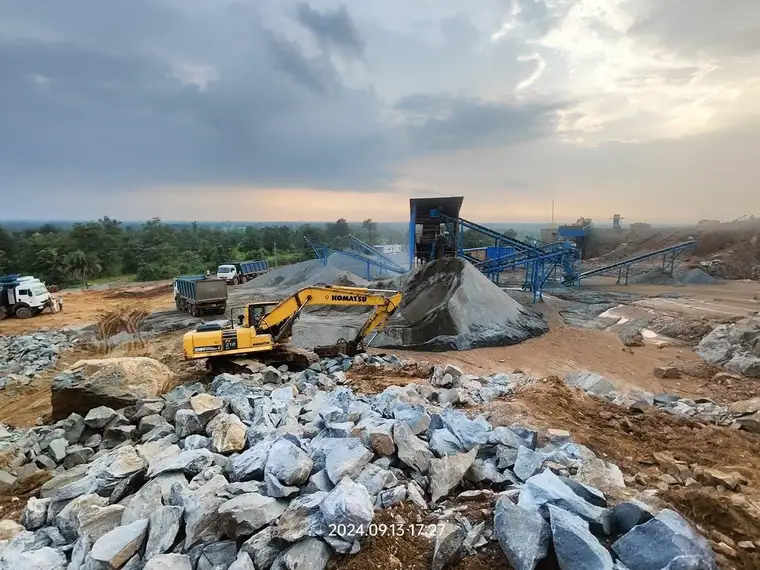
Both come off the same three-stage plant. The primary jaw, secondary cone and tertiary stage do the same work either way. What changes is behind them: which screen decks are fitted, how the fractions are blended, and which stockpile the product goes to. On our crushing plants a change of specified grading is a change of decks, about a shift of work.
The two materials need separate stockpiles on clean ground, because one bucket of GSB in a WMM bin shows up in the next sieve analysis. The road needs GSB first and WMM behind it, so a plant can build GSB stock early and move its output towards base course fractions as the paving front opens. A single 250 TPH plant on two shifts is rated for up to 1,00,000 MT a month across everything it makes. Agree the monthly split between sub-base, base and the single sizes for DBM and concrete before the first tonne, not during a shortage.
What to put in the order
- The material and the clause: GSB to Clause 401 or WMM to Clause 406.
- For GSB, the grading number from Table 400-1 as your contract specifies it.
- For WMM, whether you want the blended mix or separate fractions for your own mixing plant.
- Monthly tonnes of each, and the month each one starts.
- Where it is going, as a chainage or a map pin, so the lead distance can be priced.
With those five lines a plant can say on the first call whether it can hold both for your programme. Everything else off the screens is on the materials page.
Standards and sources
- MoRTH Specifications for Road and Bridge Works, Fifth Revision (2013), Clause 401, Tables 400-1 and 400-2
- MoRTH Specifications for Road and Bridge Works, Fifth Revision (2013), Clause 406, Tables 400-12 and 400-13
- MoRTH Specifications for Road and Bridge Works, Fifth Revision (2013), Section 900, Tables 900-1 and 900-3
- IRC:37-2018 Guidelines for the Design of Flexible Pavements, Clause 7.2.1
- Plant output and deck-change figures: SM Infra's own operating record
Your contract and its technical schedules override anything written here. Check the clause before you build to it.